I don't know if you've read The Leopard -- the 1958 book by Giuseppe Tomasi di Lampedusa that tells a story of social change and the decline of the nobility in 19th-century Sicily through the narrative of the Salina family and its patriarch Don Fabrizio.
I love The Leopard. I love the sensuality of the narrative and of Don Fabrizio himself. I love the way Don Fabrizio admires and supports his nephew Tancredi, even though Tancredi represents the decline of the Salina's social class. I love the way that Don Fabrizio's real interest, and true comfort, lies in astronomy and mathematics.
At one point in the story, Father Pirrone - a priest who lives with the Salina family -- is asked to reflect on what the aristocrats think about then coming shifts in social equality. And he tries to answer, he gets caught up in a long and rambling response because he doesn't know how to explain how the nobility see the world and how different it is.
In trying to express the incomprehensibility what the nobility care about and what they don't, he says "I've seen Don Fabrizio get quite testy, wise and serious though he is, because of a badly ironed collar to his shirt; and I know for certain that the Prince of Làscari didn't sleep for a whole night from rage because he was wrongly placed at one of the Viceroy's dinners."
Encountering that passage always gives me a shock of recognition in an uncomfortable way. Because I, too, am frequently thrown by small irritations. I went through a phase where if I was chopping vegetables and a small piece of something would fall on the floor, I would flip out, feel the world was against me. The problem of price stickers leaving sticky residue on elegant objects sends me into a tailspin. Sometimes I get dressed to go out, and realize my shoes won't work with the weather, and realize my outfit won't work with different shoes, and I get a complete feeling of despair come over me. Yesterday morning, my clothes hangers got tangled up and I was like OK, that's it, we're done.
I don't think I'm alone. I've seen friends in a rage because of coffee spilled on a shirt, or a glass dropped on the floor.
I used to buy into the orthodoxy of "underlying mood": that this kind of thing happens because there is an undercurrent of stress and anxiety so intense that the seeming OKness of the surface is a superficial layer, a paint job over roiling chaos. Sometimes that's true. You can always describe it that way if you want to. But often it doesn't feel that way to me. To me, it feels more like a plunge into the essential pointlessness and harrassingness of human existence, a plunge caused by the irritation itself, not requiring unusual life stress as a background condition.
At first, I was inclined to draw the conclusion that Father Pirrone's association of this experience with aristocracy was questionable. I'm not an aristocrat, and neither are my friends. But then I started wondering if maybe just being middle-class and white in North America was a kind of experience of aristocracy -- I mean, that the relevant background needs and social comforts are met at such a high general high level that our idea of what is a "problem" would be more similar to that of the Salina family than to the non-aristocrats of 19th century Sicily.
But then -- "on the third hand," as my mother liked to say -- I got to thinking, maybe Father Pirrone is wrong about it after all -- because what does Giuseppe Tomasi di Lampedusa know about it? He was the last Prince of Lampedusa and owner of a hereditary agricultural estate. He has no special insights into whether being enraged by irritations is a special aristocrat thing or more a general human thing.
I used to have a lot less money than I do now, and for a time I was in difficult circumstances. I've been trying to remember whether I was just enraged by small irritations then as I am now. But I can't quite sort it out. In my mind's eye of that time, I'm just smoking a lot of cigarettes. I do remember that when I worked as a waitress, one of my tasks was to break cold feta cheese into crumbled feta cheese with my hands, and I hated the feeling so badly, I swore I'd never do that by choice. To this day, I use a knife to chop feta into little cubes.
So: enraged by irritations: human nature or aristocratic problem? I'm really not sure. Or -- maybe it's just me?
Showing posts with label human nature. Show all posts
Showing posts with label human nature. Show all posts
Thursday, October 15, 2020
Enraged by Irritations: Human Nature Or Aristocratic Problem?

Monday, May 11, 2020
Lockdown, The Singularity, And The Idea of Post-Humanism
Back in 2010, when we were younger and more naive, a bunch of people were excited about something they called The Singularity, a time in the not-so-distant future when humanity would be replaced with ... something else. Post-humanity. A "superior intelligence that will dominate," so that life will take on a radically altered form that we cannot see and predict now.
Here at TKIN, I expressed my skepticism. Sure -- if you want to make an artificial liver or bionic limbs or whatever, awesome, I love it! But that's not post-humanity. It's the human experience, just somewhat improved. Longer, more fun, less painful, whatever. Beyond the human-upgrades interpretation, the suggestions get more radical but also more vague. We're going to meld minds and machines. We're going to upload your consciousness into a computer. You'll live forever, in some unforeseen Venn diagram overlap zone between virtual and real.
When I pondered this in 2010, I was like WTF, and now that we're in lockdown I feel even more like WTF. Aren't most the best pleasures of life embodied? In 2010 I listed sex, food, wine, sports, music, and dancing as things we like to do that are embodied, seemingly inaccessible to the computer-based post-human. And what's on the other side, on the post-human, singularity playlist? Math? Most people don't even like thinking about math.
I don't think I'm alone when I say that lockdown has made the importance of the embodied life even more vivid to me. We're sick of interacting through screens. We long for the touch of our family and friends. People are flocking to bake bread, grow plants, and acquire pets; the concept of "going for a walk to get some fresh air," at one time a symbol of a life lived quietly and meditatively, is now essential to the happiness of millions of people. I myself have taken care to notice the minute daily progress of leaves coming out on trees in my neighborhood.
I was mentally reviewing all the internet think-pieces I've read about what people are experiencing in lockdown, and the one disembodied activity now flourishing that I could spot was online chess. Touchingly, the New York Times places this news in the Sports section, where they are clearly dying for content.
Anyway, after writing that post in 2010, I expressed my doubts to some guys who were roughly in the robot-biz, and they smiled that guy-smile that comes up when a woman says something they think is stupid. It's not computer-based in that sense, they explained slowly to me. You'll still be able to do all the fun things. It's just that the whole system will be artificial, and therefore more permanent, less flawed, and better.
Fine, but as I've already said, I don't think that's post-humanity -- that's more like keeping your human self while being less susceptible to the world's problems: less vulnerable to injury, less in need of food and medical care, less dependent on others for your well-being. Our desires for life to be less difficult, less painful, less scary and less mortal are very human, and like the embodied pleasures, they have been intensified by the lockdown and the pandemic itself -- as we have all been reminded how vulnerable we are to illness and death, how challenging it is to care for others, and how fragile our little systems are.
Of course, in our radically unequal world, these things bear more heavily on some people than others, and awareness of our shared situation and our interdependence has been a bit of a wake-up call to some people who maybe used to imagine themselves as self-sufficient tech-oriented rich people.
I don't know what those people are dreaming of now, and whether it's still something like The Singularity or whether it's more like a walled city in New Zealand with a stockpile of ventilators. But whatever it is, I hope they'll remember it's not really post-humanism that they're hankering after. It's more like human life made less difficult and scary. And that dream is not only shared by everyone, it's also about the most human thing you could possibly have.
Here at TKIN, I expressed my skepticism. Sure -- if you want to make an artificial liver or bionic limbs or whatever, awesome, I love it! But that's not post-humanity. It's the human experience, just somewhat improved. Longer, more fun, less painful, whatever. Beyond the human-upgrades interpretation, the suggestions get more radical but also more vague. We're going to meld minds and machines. We're going to upload your consciousness into a computer. You'll live forever, in some unforeseen Venn diagram overlap zone between virtual and real.
When I pondered this in 2010, I was like WTF, and now that we're in lockdown I feel even more like WTF. Aren't most the best pleasures of life embodied? In 2010 I listed sex, food, wine, sports, music, and dancing as things we like to do that are embodied, seemingly inaccessible to the computer-based post-human. And what's on the other side, on the post-human, singularity playlist? Math? Most people don't even like thinking about math.
I don't think I'm alone when I say that lockdown has made the importance of the embodied life even more vivid to me. We're sick of interacting through screens. We long for the touch of our family and friends. People are flocking to bake bread, grow plants, and acquire pets; the concept of "going for a walk to get some fresh air," at one time a symbol of a life lived quietly and meditatively, is now essential to the happiness of millions of people. I myself have taken care to notice the minute daily progress of leaves coming out on trees in my neighborhood.
I was mentally reviewing all the internet think-pieces I've read about what people are experiencing in lockdown, and the one disembodied activity now flourishing that I could spot was online chess. Touchingly, the New York Times places this news in the Sports section, where they are clearly dying for content.
Anyway, after writing that post in 2010, I expressed my doubts to some guys who were roughly in the robot-biz, and they smiled that guy-smile that comes up when a woman says something they think is stupid. It's not computer-based in that sense, they explained slowly to me. You'll still be able to do all the fun things. It's just that the whole system will be artificial, and therefore more permanent, less flawed, and better.
Fine, but as I've already said, I don't think that's post-humanity -- that's more like keeping your human self while being less susceptible to the world's problems: less vulnerable to injury, less in need of food and medical care, less dependent on others for your well-being. Our desires for life to be less difficult, less painful, less scary and less mortal are very human, and like the embodied pleasures, they have been intensified by the lockdown and the pandemic itself -- as we have all been reminded how vulnerable we are to illness and death, how challenging it is to care for others, and how fragile our little systems are.
Of course, in our radically unequal world, these things bear more heavily on some people than others, and awareness of our shared situation and our interdependence has been a bit of a wake-up call to some people who maybe used to imagine themselves as self-sufficient tech-oriented rich people.
I don't know what those people are dreaming of now, and whether it's still something like The Singularity or whether it's more like a walled city in New Zealand with a stockpile of ventilators. But whatever it is, I hope they'll remember it's not really post-humanism that they're hankering after. It's more like human life made less difficult and scary. And that dream is not only shared by everyone, it's also about the most human thing you could possibly have.
Tuesday, November 7, 2017
The Opioid Epidemic As A Crisis Of System, Not Individuals
Like a lot of people I was gripped by this New Yorker story about the Purdue Pharma company and its role in creating and perpetuating the opioid epidemic. And, presumably like a lot of people, I was appalled by various aspects of the story -- like massive efforts to hide the addictive nature of the drug even in the face of massive harm.
But as I read along, I was also a bit weirded out by the focus on the individual family members who run Purdue Pharma. One reason this weirded me out is that a lot of the story seemed to involve examples of people doing everything they can to defend and preserve their company and their product. But isn't the way capitalism works in our society predicated on the idea that this is what people do?
We've known forever that if you create a system in which some of the methods you can use to get ahead will be collectively destructive, people will be incentivized to use those methods. And I would say recent history supports the idea that if you want that not to happen, you can't rely just on some vague notion like individual responsibility. You need systems in place.
That's why we have things like the FDA, and policies about conflicts of interest, and so on. Why wasn't more of this story about that?
The article describes various kinds of factors leading to the crisis. Sales reps were trained in "overcoming objections" from clinicians, sometimes with exaggerated or false information, where doctors were vulnerable because of "wishful thinking" -- they wanted a pill that would help their patients. Purdue paid clinicians to attend medical conferences and give presentations about the merits of the drug -- in places like Boca Raton. The marketing thus involved a deadly circularity: "the company convinced doctors of the drug’s safety with literature that had been produced by doctors who were paid, or funded, by the company." They "duped" the FDA into thinking the drug lasted 12 hours and wasn't addictive. They created a concept of "pseudo-addiction," which they said explained addiction-like symptoms in terms of under-treatment of pain.
Yes -- there is a lot of bad behavior here. But what was supposed to prevent this from happening? Modern capitalism is a cut-throat business. In a society where American Airlines can be criticized for raising pay for pilots and flight attendants, there are huge incentives in place to do whatever's necessary to make your product sell. If other people are behaving badly, you may have to behave badly too, just to stay in business.
I had always thought that this is why we have rules and systems in place. Isn't the FDA supposed to work on principles that make it extra difficult for an individual company to "dupe" it? Didn't there used to be stronger rules about conflicts-of-interest? This is one reason in the past that advertising wasn't allows for drugs -- as the article says, "advertising has always entailed some degree of persuasive license." What happened to that idea?
The company -- and the family who run it -- have been sued in court, but have settled, often for sums said to be small compared to the cost of righting the wrongs in question. In some cases, they have been ordered to pay fines, but again, the amounts won't make a dent in their profits. The article quotes Arlen Specter, the Republican senator from Pennsylvania, remarking that such fines amounted to "expensive licenses for criminal misconduct."
These all reflect problems with the system. Regular readers may remember a previous post on this issue discussing Sam Quinones's excellent book Dreamland. One thing that Quinones says is how often the people mitigating disaster and finding solutions come from some kind of governmental or collective institution or agency: they are in the court system, or the health care system, or whatever. Yes, there are people doing bad things and good things but everyone is ultimately caught up in a web of conflicting societal needs and pressures. This is a very different -- and I think more enlightening -- perspective.
The article lambasts the individual family members who run Purdue Pharma, asking how they can possibly live with themselves. I get that. But so many of us are complicit in some kind of awfulness -- buying gadgets with conflict minerals, depositing carbon into the air for holidays, enjoying the fruits of energy from companies engaging in global exploitation. In our society, complicity in harm is not restricted to a few bad actors.
As we've said before in this space, blaming corporate "greed" is often naive and misplaced, because in our corporate world, if you're not as cut-throat as the next guy, you're going to fail. It's not an "individual responsibility" sort of thing. It's a system thing. Sometimes, the framing of individual actors as good or bad loses some of its usefulness. Modern capitalism may be one of those times.
But as I read along, I was also a bit weirded out by the focus on the individual family members who run Purdue Pharma. One reason this weirded me out is that a lot of the story seemed to involve examples of people doing everything they can to defend and preserve their company and their product. But isn't the way capitalism works in our society predicated on the idea that this is what people do?
We've known forever that if you create a system in which some of the methods you can use to get ahead will be collectively destructive, people will be incentivized to use those methods. And I would say recent history supports the idea that if you want that not to happen, you can't rely just on some vague notion like individual responsibility. You need systems in place.
That's why we have things like the FDA, and policies about conflicts of interest, and so on. Why wasn't more of this story about that?
The article describes various kinds of factors leading to the crisis. Sales reps were trained in "overcoming objections" from clinicians, sometimes with exaggerated or false information, where doctors were vulnerable because of "wishful thinking" -- they wanted a pill that would help their patients. Purdue paid clinicians to attend medical conferences and give presentations about the merits of the drug -- in places like Boca Raton. The marketing thus involved a deadly circularity: "the company convinced doctors of the drug’s safety with literature that had been produced by doctors who were paid, or funded, by the company." They "duped" the FDA into thinking the drug lasted 12 hours and wasn't addictive. They created a concept of "pseudo-addiction," which they said explained addiction-like symptoms in terms of under-treatment of pain.
Yes -- there is a lot of bad behavior here. But what was supposed to prevent this from happening? Modern capitalism is a cut-throat business. In a society where American Airlines can be criticized for raising pay for pilots and flight attendants, there are huge incentives in place to do whatever's necessary to make your product sell. If other people are behaving badly, you may have to behave badly too, just to stay in business.
I had always thought that this is why we have rules and systems in place. Isn't the FDA supposed to work on principles that make it extra difficult for an individual company to "dupe" it? Didn't there used to be stronger rules about conflicts-of-interest? This is one reason in the past that advertising wasn't allows for drugs -- as the article says, "advertising has always entailed some degree of persuasive license." What happened to that idea?
The company -- and the family who run it -- have been sued in court, but have settled, often for sums said to be small compared to the cost of righting the wrongs in question. In some cases, they have been ordered to pay fines, but again, the amounts won't make a dent in their profits. The article quotes Arlen Specter, the Republican senator from Pennsylvania, remarking that such fines amounted to "expensive licenses for criminal misconduct."
These all reflect problems with the system. Regular readers may remember a previous post on this issue discussing Sam Quinones's excellent book Dreamland. One thing that Quinones says is how often the people mitigating disaster and finding solutions come from some kind of governmental or collective institution or agency: they are in the court system, or the health care system, or whatever. Yes, there are people doing bad things and good things but everyone is ultimately caught up in a web of conflicting societal needs and pressures. This is a very different -- and I think more enlightening -- perspective.
The article lambasts the individual family members who run Purdue Pharma, asking how they can possibly live with themselves. I get that. But so many of us are complicit in some kind of awfulness -- buying gadgets with conflict minerals, depositing carbon into the air for holidays, enjoying the fruits of energy from companies engaging in global exploitation. In our society, complicity in harm is not restricted to a few bad actors.
As we've said before in this space, blaming corporate "greed" is often naive and misplaced, because in our corporate world, if you're not as cut-throat as the next guy, you're going to fail. It's not an "individual responsibility" sort of thing. It's a system thing. Sometimes, the framing of individual actors as good or bad loses some of its usefulness. Modern capitalism may be one of those times.
Tuesday, September 26, 2017
Nothing Human Is Just Biology: Kid And Food Edition
About a year and a half ago, the New York Times ran this story by a mother whose baby girl Violet was born with a heart defect and who, as a result of complex treatments for that, ended up with another problem: she didn't eat.
You should read the whole story, because it is emotionally moving, intellectually sophisticated, and philosophically interesting. Basically, her daughter needed a temporary nasogastral feeding tube, and after that were various struggles to get her to eat. But she was so weak, she never could get more calories than she spent, and she grew to associate eating with pain and suffering. This aversion to eating was so severe that they had to continue with the tube.
Heartbreakingly, the tube intensified Violet's aversion to eating. Once a week it had to be changed; her parents had to hold her down while she screamed and cried and then they had to wait til she stopped to breath to try to get it down her throat. Horrible. Of course, after that, Violet didn't want anything near her mouth, ever. When Violet was around six months old, they put in a permanent tube directly into her stomach. As her mother says, "devastating." And also "a relief."
Not surprisingly, given modern medicine, Violet's story is common, and the essay discusses the various approaches experts take to try to reintroduce children to the feeling that eating is something they can and want to do. Many take a behavioral approach. Because a big part of "oral aversion" is the association between pain and food, a lot of this involves creating positive external associations with foods -- for example, associating successful eating with toys -- and reinforcement that eating is going to happen. When another child in treatment eats she gets rewarded; but when she spits out her food, the therapist feeds it back to her.
A slightly different approach involves trying to reconnect the child with the internal cues of hunger and pleasure. Of course, this is tricky and potentially dangerous, since you have to let the child feel hunger, which means you have to feed them, through the tube, less food than they need, which must be terrifying with a child whose health is already a bit shaky.
One of the interesting aspects of the latter approach is the idea that to associate food with pleasure, you have to let kids spit out food and not worry about it. Violet's mother describes how, when they were beginning, Violet would put a bit of food, and then eventually more food, into her mouth, and then -- instead of swallowing, she'd spit it all out. Frustrating! but the therapist says that spitting is an essential part of the process: it lets Violet know that she can spit it out, so it is safe to experiment with another bite.
The first time through, at this point in the story, I didn't really know how it was all going to turn out. Was Violet going to be able to eat? Before I got to the textual resolution of this question, I came across a photo accompanying the story. The photos before had all been of Violet with her tubes. But in this one, she had chocolate avocado pudding all over her face, with a huge smile because -- yes, she was eating it! The image brought tears to my eyes the first time, and then it did again an hour ago when I reread the story.
After getting Violet to disassociate food and pain and associate food with pleasure -- or, at least, curiosity -- they had to let Violet get hungrier and hungrier. But in the end, it worked. Like a month later, they're all out at a diner and Violet is scarfing down a grilled cheese sandwich.
This story came out in early 2016 but I think about it regularly, even now. Partly I guess it's because it's interesting and happy, which so few things are these days. But partly I think it's because it shows something important about human nature. That everything -- even something so seemingly straightforward as eating, transcends biology. Everything is social and environmental.
In some philosophy I was doing with a student recently we were talking about the idea of idealizing people as if they were "mushroom men" -- people who sprang from the earth as fully formed adults, ready to make decisions, form goals, and negotiate with others for what they need. This was in the context of talking about economics, where sometimes the metaphor is used to explicate models of economic rationality and exchange. But of course it's long been central to philosophy as well, for example in the contractarian and contractualist traditions in historical philosophers like Hobbes and, to a certain extent, in more contemporary ones like Rawls.
Like all idealizations, this one might work better in some contexts and worse in others, it might capture or obscure what we want to see in certain settings, it might be more or less of a misrepresentation depending on what we're using it for.
Still, I found the story a great reminder of how far from that we really are. It's not just that when we're small, we're temporarily unable to forage for food or work at jobs. It's also that everything we do -- even something like eating! -- depends on a fragile and contingent network of things happening and people who love us there to make sure those things work the way they're supposed to.
You should read the whole story, because it is emotionally moving, intellectually sophisticated, and philosophically interesting. Basically, her daughter needed a temporary nasogastral feeding tube, and after that were various struggles to get her to eat. But she was so weak, she never could get more calories than she spent, and she grew to associate eating with pain and suffering. This aversion to eating was so severe that they had to continue with the tube.
Heartbreakingly, the tube intensified Violet's aversion to eating. Once a week it had to be changed; her parents had to hold her down while she screamed and cried and then they had to wait til she stopped to breath to try to get it down her throat. Horrible. Of course, after that, Violet didn't want anything near her mouth, ever. When Violet was around six months old, they put in a permanent tube directly into her stomach. As her mother says, "devastating." And also "a relief."
Not surprisingly, given modern medicine, Violet's story is common, and the essay discusses the various approaches experts take to try to reintroduce children to the feeling that eating is something they can and want to do. Many take a behavioral approach. Because a big part of "oral aversion" is the association between pain and food, a lot of this involves creating positive external associations with foods -- for example, associating successful eating with toys -- and reinforcement that eating is going to happen. When another child in treatment eats she gets rewarded; but when she spits out her food, the therapist feeds it back to her.
A slightly different approach involves trying to reconnect the child with the internal cues of hunger and pleasure. Of course, this is tricky and potentially dangerous, since you have to let the child feel hunger, which means you have to feed them, through the tube, less food than they need, which must be terrifying with a child whose health is already a bit shaky.
One of the interesting aspects of the latter approach is the idea that to associate food with pleasure, you have to let kids spit out food and not worry about it. Violet's mother describes how, when they were beginning, Violet would put a bit of food, and then eventually more food, into her mouth, and then -- instead of swallowing, she'd spit it all out. Frustrating! but the therapist says that spitting is an essential part of the process: it lets Violet know that she can spit it out, so it is safe to experiment with another bite.
The first time through, at this point in the story, I didn't really know how it was all going to turn out. Was Violet going to be able to eat? Before I got to the textual resolution of this question, I came across a photo accompanying the story. The photos before had all been of Violet with her tubes. But in this one, she had chocolate avocado pudding all over her face, with a huge smile because -- yes, she was eating it! The image brought tears to my eyes the first time, and then it did again an hour ago when I reread the story.
After getting Violet to disassociate food and pain and associate food with pleasure -- or, at least, curiosity -- they had to let Violet get hungrier and hungrier. But in the end, it worked. Like a month later, they're all out at a diner and Violet is scarfing down a grilled cheese sandwich.
This story came out in early 2016 but I think about it regularly, even now. Partly I guess it's because it's interesting and happy, which so few things are these days. But partly I think it's because it shows something important about human nature. That everything -- even something so seemingly straightforward as eating, transcends biology. Everything is social and environmental.
In some philosophy I was doing with a student recently we were talking about the idea of idealizing people as if they were "mushroom men" -- people who sprang from the earth as fully formed adults, ready to make decisions, form goals, and negotiate with others for what they need. This was in the context of talking about economics, where sometimes the metaphor is used to explicate models of economic rationality and exchange. But of course it's long been central to philosophy as well, for example in the contractarian and contractualist traditions in historical philosophers like Hobbes and, to a certain extent, in more contemporary ones like Rawls.
Like all idealizations, this one might work better in some contexts and worse in others, it might capture or obscure what we want to see in certain settings, it might be more or less of a misrepresentation depending on what we're using it for.
Still, I found the story a great reminder of how far from that we really are. It's not just that when we're small, we're temporarily unable to forage for food or work at jobs. It's also that everything we do -- even something like eating! -- depends on a fragile and contingent network of things happening and people who love us there to make sure those things work the way they're supposed to.
Monday, September 11, 2017
Can The Pursuit Of Pleasure Be An Addiction If It's Also Normal Human Life?
When I saw this headline -- "The pursuit of pleasure is a modern-day addiction -- I thought the piece might be some kind of joke or parody.
I mean, I know some people have expanded the scope of "addition" so that it includes things like shopping and carbohydrates, and I know other people can get agitated about that expansion, as if it implies that a chocolate habit and a cocaine habit are somehow on a par. But at least shopping and carbohydrates are actual specific things. And there's no question that these things can be "addictive" in the sense that the more you get the get the more you want.
But pleasure? I mean, that's not a thing you do or ingest, it's more a part of the human experience. How can you be addicted to a part of the human experience? Plus, isn't pleasure the mechanism through which those other things become so habit-forming? What does it mean to reduce the addiction to the very mechanism that makes them work?
I'm no expert on human psychobiology, but isn't pleasure supposed to be one of the main motivating forces of life? Isn't the pursuit of pleasure one of the central reasons people do things? How could it also be a pathological addiction?
And finally, what's a life without pleasure? The author of the piece, Robert Lustig is famous for his view that sugar is a poison. So is the idea that anything pleasurable is also bad? So .. even healthy food shouldn't be consumed because it is enjoyable to eat? WTF?
When I read the piece, it didn't seem quite as absurd as I thought it would be. When you get past the headline, there are more specific examples of ways in which particular pleasures are out of control. A fondness for soda leads to the "big gulp"; the love of likes leads to chronic Instagram checking. Constant stress and anxiety create the backdrop in which we're in constant need of the feel good chemicals in our brain, just to feel OK. To get the feel good chemicals, we do more and more of the "pleasure things," and get less and less out of them, and so on and so on. I guess you could describe that as being addicted to pleasure.
As regular readers of this blog may expect, I can never read things like this without thinking of the ways that these effects are sort of built into the whole capitalist system. What's more successful in capitalism than a commodity that the more people have of them the more they want? Armies of food technologists work day and night to bring about exactly this state of affairs. Whole university departments exist to train people how to do it. How is it surprising that this is where we've ended up?
Later in the essay, Lustig goes back to the more general idea that somehow it's pleasure itself that is the problem, and there he says that to live the right way we should seek "happiness" rather than pleasure. It's funny, because I was just getting ready to teach Mill, and we were going to talk about his "greatest happiness principle" where he says that "actions are right in proportion as they tend to promote happiness, wrong as they tend to produce the reverse of happiness. By happiness is intended pleasure, and the absence of pain; by unhappiness pain, and the privation of pleasure.” So maybe Mill things happiness and pleasure are the same, or at least that he thinks we can use the words interchangeably. On the other hand, Mill famously distinguished between "higher" and "lower" pleasures so who knows.
Lustig says that "the more pleasure you seek, the more unhappy you get and the more likelihood you will slide into addiction or depression" and that "our ability to perceive happiness has been sabotaged by our modern incessant quest for pleasure, which our consumer culture has made all too easy to satisfy."
I see what he's getting at, but there seems to me something strange about the formulation. People have always sought pleasure, haven't they? So it's the world that's changing, not human nature. It seems to me like we just have a lot more easy sources of pleasure. As we've long said on this blog, easy sources of pleasure are difficult for humans: you think you want treats, but by definition a treat is a thing you don't get all the time. So.. how do you keep it in check? Before you know it, it you've cascaded into a misery of self-denial, living both as tyrant and supplicant, begging yourself for those treats that you yourself decided you can't have too much of.
But again, I think people have always been like that. It's OK to love pleasure. It's our modern surroundings that are the problem, not us.
I mean, I know some people have expanded the scope of "addition" so that it includes things like shopping and carbohydrates, and I know other people can get agitated about that expansion, as if it implies that a chocolate habit and a cocaine habit are somehow on a par. But at least shopping and carbohydrates are actual specific things. And there's no question that these things can be "addictive" in the sense that the more you get the get the more you want.
But pleasure? I mean, that's not a thing you do or ingest, it's more a part of the human experience. How can you be addicted to a part of the human experience? Plus, isn't pleasure the mechanism through which those other things become so habit-forming? What does it mean to reduce the addiction to the very mechanism that makes them work?
I'm no expert on human psychobiology, but isn't pleasure supposed to be one of the main motivating forces of life? Isn't the pursuit of pleasure one of the central reasons people do things? How could it also be a pathological addiction?
And finally, what's a life without pleasure? The author of the piece, Robert Lustig is famous for his view that sugar is a poison. So is the idea that anything pleasurable is also bad? So .. even healthy food shouldn't be consumed because it is enjoyable to eat? WTF?
When I read the piece, it didn't seem quite as absurd as I thought it would be. When you get past the headline, there are more specific examples of ways in which particular pleasures are out of control. A fondness for soda leads to the "big gulp"; the love of likes leads to chronic Instagram checking. Constant stress and anxiety create the backdrop in which we're in constant need of the feel good chemicals in our brain, just to feel OK. To get the feel good chemicals, we do more and more of the "pleasure things," and get less and less out of them, and so on and so on. I guess you could describe that as being addicted to pleasure.
As regular readers of this blog may expect, I can never read things like this without thinking of the ways that these effects are sort of built into the whole capitalist system. What's more successful in capitalism than a commodity that the more people have of them the more they want? Armies of food technologists work day and night to bring about exactly this state of affairs. Whole university departments exist to train people how to do it. How is it surprising that this is where we've ended up?
Later in the essay, Lustig goes back to the more general idea that somehow it's pleasure itself that is the problem, and there he says that to live the right way we should seek "happiness" rather than pleasure. It's funny, because I was just getting ready to teach Mill, and we were going to talk about his "greatest happiness principle" where he says that "actions are right in proportion as they tend to promote happiness, wrong as they tend to produce the reverse of happiness. By happiness is intended pleasure, and the absence of pain; by unhappiness pain, and the privation of pleasure.” So maybe Mill things happiness and pleasure are the same, or at least that he thinks we can use the words interchangeably. On the other hand, Mill famously distinguished between "higher" and "lower" pleasures so who knows.
Lustig says that "the more pleasure you seek, the more unhappy you get and the more likelihood you will slide into addiction or depression" and that "our ability to perceive happiness has been sabotaged by our modern incessant quest for pleasure, which our consumer culture has made all too easy to satisfy."
I see what he's getting at, but there seems to me something strange about the formulation. People have always sought pleasure, haven't they? So it's the world that's changing, not human nature. It seems to me like we just have a lot more easy sources of pleasure. As we've long said on this blog, easy sources of pleasure are difficult for humans: you think you want treats, but by definition a treat is a thing you don't get all the time. So.. how do you keep it in check? Before you know it, it you've cascaded into a misery of self-denial, living both as tyrant and supplicant, begging yourself for those treats that you yourself decided you can't have too much of.
But again, I think people have always been like that. It's OK to love pleasure. It's our modern surroundings that are the problem, not us.
Tuesday, May 23, 2017
Hurt Feelings And The Perverse Modern Demand For Invulnerability
Have you seen that comic strip that shows the guy hearing all kinds of praise and one bad thing, and how in the course of the day the praise fades and fades to nothing, 'til when he's lying in bed and all he can think is of that one bad thing?
Here it is:
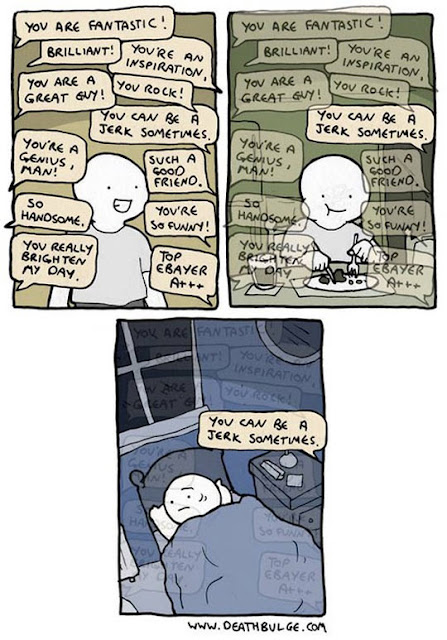
I think about this comic all the time, because I am very susceptible to this. In the comic, the one negative thing the guy can't get out of his head is "you're a jerk," but my negative things range over all types and categories and can include both comments from other that, for whatever reasons, hurt my feelings, and also vicious negative self-assessment.
Anyone who teaches students can tell you about experiencing this with course evaluations. You can read one positive comment after another, sheet after sheet where the only negative feedback is "the readings were dry," and then you come upon someone who says you're incompetent or boring or disorganized or behind-the-times and -- WHAM. I promise, that is the comment you'll be thinking about for the next few weeks, or maybe forever.
I discuss this comic strip with people often, because it's important to remember what a widely shared experience it is and to keep in mind that feeling this way doesn't make you weak or weird or over-reacting or anything. It's just human nature.
When I share this comic strip and think about it, my mind often turns to thinking about how crazy it is that as humans hyper-sensitive to negative feedback, we've basically created a system in which people are constantly subjected to it. You'd think if we were people like the guy in the comic strip that we would find a way to create a society in which we are surrounded by praise and positive comments and only hear negative feedback in the gentlest and most constructive way.
But it's not like that at all. It's like the opposite. Most of us are surrounded with critical evaluation from all sides and only hear praise if we're lucky enough to have people around who love and care for us.
Worst of all, the people who are -- or who act -- the most impervious to criticism are often the people who are most successful. They exude positivity, and they prop up their personal brand and likability.
It is one of those strange states of affairs: we have massive human vulnerability, and modern society is set up for massive invulnerability. Like we set up society for people radically unlike ourselves. WTF?
I don't know how you undo any of these complicated systemic things that no one really designed, and that seem to emerge out of the always churning blend of capitalism, the Human Resources industrial complex, and people just needing to lord it over other people. But wouldn't it be nice if we could shift things around a little?
Here it is:

I think about this comic all the time, because I am very susceptible to this. In the comic, the one negative thing the guy can't get out of his head is "you're a jerk," but my negative things range over all types and categories and can include both comments from other that, for whatever reasons, hurt my feelings, and also vicious negative self-assessment.
Anyone who teaches students can tell you about experiencing this with course evaluations. You can read one positive comment after another, sheet after sheet where the only negative feedback is "the readings were dry," and then you come upon someone who says you're incompetent or boring or disorganized or behind-the-times and -- WHAM. I promise, that is the comment you'll be thinking about for the next few weeks, or maybe forever.
I discuss this comic strip with people often, because it's important to remember what a widely shared experience it is and to keep in mind that feeling this way doesn't make you weak or weird or over-reacting or anything. It's just human nature.
When I share this comic strip and think about it, my mind often turns to thinking about how crazy it is that as humans hyper-sensitive to negative feedback, we've basically created a system in which people are constantly subjected to it. You'd think if we were people like the guy in the comic strip that we would find a way to create a society in which we are surrounded by praise and positive comments and only hear negative feedback in the gentlest and most constructive way.
But it's not like that at all. It's like the opposite. Most of us are surrounded with critical evaluation from all sides and only hear praise if we're lucky enough to have people around who love and care for us.
Worst of all, the people who are -- or who act -- the most impervious to criticism are often the people who are most successful. They exude positivity, and they prop up their personal brand and likability.
It is one of those strange states of affairs: we have massive human vulnerability, and modern society is set up for massive invulnerability. Like we set up society for people radically unlike ourselves. WTF?
I don't know how you undo any of these complicated systemic things that no one really designed, and that seem to emerge out of the always churning blend of capitalism, the Human Resources industrial complex, and people just needing to lord it over other people. But wouldn't it be nice if we could shift things around a little?
Tuesday, April 18, 2017
The New Myers-Briggs
I've always thought that the Myers-Briggs test -- like most psychological classification tests -- had a kind of bullshitty aspect to it. But for some reason. the human urge to develop acronyms and short quizzes to unlock the mysteries of our inner lives seems unsatisfiable. So, in that spirit, here are some other categories I like to use to understand other people.
1. "Straight Man" Versus "Funny Man."
We live in a very fucked up world. As I see it, you can either laugh at the ridiculous of the world directly, or you can take up the quieter, more subtle, implicit side-eye approach. In defining "straight man," Wikipedia says "The ability to maintain a serious demeanor in the face of even the most preposterous comedy is crucial to a successful straight man." But this is a bit narrow. How about "in the face of even them most preposterous .. well, anything?"
Personally, I wish I'd learned about the whole straight man concept at a younger age. When I was around eight years old, I had a friend named Katie who was not only a creative genius but also a classic "funny man." We wrote and performed for our parents a serious of comedy sketches based on two characters: I was the stern and angry school principal (Mr. Valteman), and she was the carefree, rebellious teen (I had an awesome purple vinyl jacket that worked perfectly for her costume). Over and over, she'd call me "Mr. V," and flash the peace sign or whatever, and over and over I'd bring down on her head all the impotent rage that principals have brought down all through the centuries.
At the time, I thought she was the star of the show and I was kind of an also-ran. What I didn't know is that the straight man is a crucial ingredient. Now, I get it: you actually don't even need a funny man to be a great straight man. All you need is to live among absurdity (check), show that you know you do, and say your piece with a straight face.
2. Lolcat Versus Doge
I know these are dated memes. But philosophy moves slowly.
I am a cat person along any available dimension you can outline, so it's not surprising that I love looking at pictures of cats in different poses, pictures of cats with captions, and pictures of cats with words printed on them.
What is a bit surprising -- or, at least, it surprised me -- was the degree to which I was left cold by the Doge meme. You know, where there's a picture of that Shiba Inu and there are words around it. I am left so cold by this meme that I don't even know the sense in which it is meant to be charming. Is it supposed to be funny? cute? meta?
There is something deep being shared and communicated by people who love this meme that is utterly and completely lost on me.
3. The Terror of Activity Versus the Terror of Inactivity
Rationally enough, some people's anxieties are triggered by things. They have to do something, or be somewhere. They have to talk on the phone, or organize some papers, or meet a deadline. They become anxious, and they dream of a world where all of that fades away: things are taken care of, there's nothing else they have to do, and they can rest quietly on a sofa in a softly lit room.
While I share the normal human tendency toward dread and fear of doing things, I'm actually more likely to be reduced to despair by a quiet and empty day. Time to think means ... time to think. And thinking leads me nowhere good. You start by asking yourself what to do, you move on to asking what the point of various activities are, and before long you're either 1) wasting the whole day looking at the internet or 2) staring down the existential crisis that life is, actually, totally pointless.
This is the terror of inactivity.
Unlike the old Myers-Briggs proponents, I don't claim that psychological insight into these types will help you figure out, as we would have said in the 70s, the "color of your parachute." But isn't it more interesting and fun to know you're a straight man, than, say, an INTJ?
1. "Straight Man" Versus "Funny Man."
We live in a very fucked up world. As I see it, you can either laugh at the ridiculous of the world directly, or you can take up the quieter, more subtle, implicit side-eye approach. In defining "straight man," Wikipedia says "The ability to maintain a serious demeanor in the face of even the most preposterous comedy is crucial to a successful straight man." But this is a bit narrow. How about "in the face of even them most preposterous .. well, anything?"
Personally, I wish I'd learned about the whole straight man concept at a younger age. When I was around eight years old, I had a friend named Katie who was not only a creative genius but also a classic "funny man." We wrote and performed for our parents a serious of comedy sketches based on two characters: I was the stern and angry school principal (Mr. Valteman), and she was the carefree, rebellious teen (I had an awesome purple vinyl jacket that worked perfectly for her costume). Over and over, she'd call me "Mr. V," and flash the peace sign or whatever, and over and over I'd bring down on her head all the impotent rage that principals have brought down all through the centuries.
At the time, I thought she was the star of the show and I was kind of an also-ran. What I didn't know is that the straight man is a crucial ingredient. Now, I get it: you actually don't even need a funny man to be a great straight man. All you need is to live among absurdity (check), show that you know you do, and say your piece with a straight face.
2. Lolcat Versus Doge
I know these are dated memes. But philosophy moves slowly.
I am a cat person along any available dimension you can outline, so it's not surprising that I love looking at pictures of cats in different poses, pictures of cats with captions, and pictures of cats with words printed on them.
What is a bit surprising -- or, at least, it surprised me -- was the degree to which I was left cold by the Doge meme. You know, where there's a picture of that Shiba Inu and there are words around it. I am left so cold by this meme that I don't even know the sense in which it is meant to be charming. Is it supposed to be funny? cute? meta?
There is something deep being shared and communicated by people who love this meme that is utterly and completely lost on me.
3. The Terror of Activity Versus the Terror of Inactivity
Rationally enough, some people's anxieties are triggered by things. They have to do something, or be somewhere. They have to talk on the phone, or organize some papers, or meet a deadline. They become anxious, and they dream of a world where all of that fades away: things are taken care of, there's nothing else they have to do, and they can rest quietly on a sofa in a softly lit room.
While I share the normal human tendency toward dread and fear of doing things, I'm actually more likely to be reduced to despair by a quiet and empty day. Time to think means ... time to think. And thinking leads me nowhere good. You start by asking yourself what to do, you move on to asking what the point of various activities are, and before long you're either 1) wasting the whole day looking at the internet or 2) staring down the existential crisis that life is, actually, totally pointless.
This is the terror of inactivity.
Unlike the old Myers-Briggs proponents, I don't claim that psychological insight into these types will help you figure out, as we would have said in the 70s, the "color of your parachute." But isn't it more interesting and fun to know you're a straight man, than, say, an INTJ?
Tuesday, January 31, 2017
Consent Is A Really Low Bar For Most Human Interaction
I was talking with someone yesterday about consent. I often think about consent in connection with sexual consent, because I teach and research in that area, but then our conversation moved on to other kinds of consent -- consent to have certain kinds of verbal interactions or other exchanges or engaging in other activities together.
And one of the things I started thinking about was about how consent is a really low bar for most human interaction. What I mean by that is: when you're interacting with people, there's a wide range of things you might concern yourself with that go way beyond whether they're consenting to something. These include things like how your words and actions make them feel in the moment, or how your words and actions are going to make them feel later, or how your words and actions are going to seem in retrospect. You might consider whether the person is is in a moment of difficulty, or doubt, or peer pressure. You might consider whether the nature of the relationship between you, or the specific tone or context, makes it difficult to disagree with or go against you.
Often with sexual consent the same things apply. We talk a lot about consent (and properly so) in the sexual domain, partly engaging in sexual activity with someone without their consent is a particularly egregious harm, so this is a morally bright line. But here, too, consent is often a low bar. If you're in a relationship with someone, and you want to discuss your sex life, and they just keep coming back to how you "consented" to every activity, that person would be acting like an asshole: shutting down the conversation that ought to be happening, about pleasure, and desire, and the texture of life and so on.
And the same thing applies more broadly. If you're asking someone personal questions, or requesting help with your school assignment or something at work, or you're trying to figure out a good way to share share domestic tasks or childcare with you, a respectful and kind person pays attention not only to agreements but also to how the other person seems to feel and the background context and so on.
Sometimes I feel like the whole consent framework is becoming so deeply woven into our way of thinking that it's hard to even see it as a thing -- it just feels like the "way things are." In so many domains we refer back to the idea that if someone agreed to something, then they have to take their lumps: if you said OK, then don't come crying to me. But this is an awful way to interact with the people you care about, and by extension, it's often a crappy way to interact with people in general.
Years ago I wrote a post about how the idea of pursuing self-interest through contract and negotiation had somehow expanded beyond the domains of business or market exchanges and into the fabric of our personal lives. In addition to the points above, I tried to say how constant negotiation was exhausting us: there's no port in the storm, no part of our lives where we can stop trying to create the self-image and situation that will allow us to get the things, like love and caring, that we need to survive.
In that older post I mentioned an idea I'd remembered reading from Simone de Beauvoir: that one reason Western patriarchical gender norms constructed "woman" as naturally nurturing and passive was just in response to this kind of problem: if you take one whole gender as naturally providing the love and care and attention -- not because of negotiation and who is consenting to what, but because that's part of who they are -- well, then the necessity of negotiation and looking out for yourself in "public life" is ameliorated. Some woman -- maybe your mother, maybe your wife -- will be there to offer care and concern. Not necessarily in public life, but domestically, at home, in personal interaction,
Currently, our ideas of "public life" and whatever is the alternative to that are mixed up together, and we're often operating in some weird hybrid domain where we're forming a friendship but also forming a career contact, or we're flirting but we're also hoping for a useful introduction, or we're hanging out but we're also hoping to impress. It's complicated and exhausting. We now know that gender equality means we're all in the problem in the same way together.
The moral, I think, is that taking other people's point of view into account is something we should see as part of normal, respectful, human interaction. Sure, consent is important. But most of what we want to do with one another is not like getting a bank loan, where you sign on the dotted line and you're good to go. Even if it is helpful as one morally bright line, consent is not the only thing, and in fact it's often pretty minimal for a way of thinking about how you treat the people around you.
And one of the things I started thinking about was about how consent is a really low bar for most human interaction. What I mean by that is: when you're interacting with people, there's a wide range of things you might concern yourself with that go way beyond whether they're consenting to something. These include things like how your words and actions make them feel in the moment, or how your words and actions are going to make them feel later, or how your words and actions are going to seem in retrospect. You might consider whether the person is is in a moment of difficulty, or doubt, or peer pressure. You might consider whether the nature of the relationship between you, or the specific tone or context, makes it difficult to disagree with or go against you.
Often with sexual consent the same things apply. We talk a lot about consent (and properly so) in the sexual domain, partly engaging in sexual activity with someone without their consent is a particularly egregious harm, so this is a morally bright line. But here, too, consent is often a low bar. If you're in a relationship with someone, and you want to discuss your sex life, and they just keep coming back to how you "consented" to every activity, that person would be acting like an asshole: shutting down the conversation that ought to be happening, about pleasure, and desire, and the texture of life and so on.
And the same thing applies more broadly. If you're asking someone personal questions, or requesting help with your school assignment or something at work, or you're trying to figure out a good way to share share domestic tasks or childcare with you, a respectful and kind person pays attention not only to agreements but also to how the other person seems to feel and the background context and so on.
Sometimes I feel like the whole consent framework is becoming so deeply woven into our way of thinking that it's hard to even see it as a thing -- it just feels like the "way things are." In so many domains we refer back to the idea that if someone agreed to something, then they have to take their lumps: if you said OK, then don't come crying to me. But this is an awful way to interact with the people you care about, and by extension, it's often a crappy way to interact with people in general.
Years ago I wrote a post about how the idea of pursuing self-interest through contract and negotiation had somehow expanded beyond the domains of business or market exchanges and into the fabric of our personal lives. In addition to the points above, I tried to say how constant negotiation was exhausting us: there's no port in the storm, no part of our lives where we can stop trying to create the self-image and situation that will allow us to get the things, like love and caring, that we need to survive.
In that older post I mentioned an idea I'd remembered reading from Simone de Beauvoir: that one reason Western patriarchical gender norms constructed "woman" as naturally nurturing and passive was just in response to this kind of problem: if you take one whole gender as naturally providing the love and care and attention -- not because of negotiation and who is consenting to what, but because that's part of who they are -- well, then the necessity of negotiation and looking out for yourself in "public life" is ameliorated. Some woman -- maybe your mother, maybe your wife -- will be there to offer care and concern. Not necessarily in public life, but domestically, at home, in personal interaction,
Currently, our ideas of "public life" and whatever is the alternative to that are mixed up together, and we're often operating in some weird hybrid domain where we're forming a friendship but also forming a career contact, or we're flirting but we're also hoping for a useful introduction, or we're hanging out but we're also hoping to impress. It's complicated and exhausting. We now know that gender equality means we're all in the problem in the same way together.
The moral, I think, is that taking other people's point of view into account is something we should see as part of normal, respectful, human interaction. Sure, consent is important. But most of what we want to do with one another is not like getting a bank loan, where you sign on the dotted line and you're good to go. Even if it is helpful as one morally bright line, consent is not the only thing, and in fact it's often pretty minimal for a way of thinking about how you treat the people around you.
Tuesday, December 20, 2016
Culture And Identity Everywhere, Or, Where Are The Reluctant Vegetarians?
For a long time, I used to be a vegetarian. It was for ethical reasons only: I've always loved to eat meat. OK maybe it wasn't for such a long time, but it was .. maybe 15 years or something.
For various reasons it all kind of fell apart around the time I moved from California to Canada in 2004. For one thing, I had persistently low ferritin -- and yes, you can take iron supplements for that, but no, it's not easy or straightforward, since they upset your stomach and make you feel gross. For another, I suck at pre-preparing food; I found that in Canada, going out for a quick lunch as a vegetarian often meant a pile of pasta or a pile of French fries or a grilled cheese sandwich -- all foods that are fine as a one-off but disgusting if you eat them every day. And then I accidentally ate some mistranslated poultry while traveling in France, and I was like "OMG, this tastes amazing."
Even my feminism tended me toward meat eating: as a steak-lover, I was super-pissed about all the men out there enjoying steak, and never giving it a second thought, while here I was worrying and depriving myself. Well -- I thought -- I'm going to eat it too, so there.
All this time I've had some vague cognitive dissonance, but honestly there's so much else going on in the world to be upset about that I found it hard to prioritize. But then recently I kept seeing references to meat-eating's effect on the environment and contribution to climate change, and I kept remembering the reasons I'd been a vegetarian in the first place. I read Oryx and Crake, which paints a disturbingly plausible dystopian future of our relations to our animal friends. Plus, I remembered the symbolism of it -- the feeling that regardless of whether your actions are "making a difference," at least there's that feeling that you're standing up for something that isn't actively contributing to a status quo that is frankly pretty deeply screwed up.
So a few months ago I decided I could at least do this: eat vegetarian when it's easy to do so. It's easy at a lot of restaurants. It's pretty easy when I'm at home by myself -- especially since I actually like tofu. Where I teach, you can now get some decent felafel, so it's pretty easy to do on campus.
Since I started doing this, I keep finding two things: one, how few restaurants offer decent vegetarian food, and two, how many people associate vegetarianism with somehow not liking meat or not wanting to eat it or regarding it as somehow unhealthy or gross.
These are bizarre to me. I mean, it's 2016. Aren't vegetarians everywhere? And don't they want to eat with non-vegetarians? Sometimes fancier restaurants do OK, though often it's just some crappy pasta thing like pumpkin ravioli that is basically starch on starch filled with starch. Kind of blech. The real puzzle, though, is casual places and pubs. If you're serving burgers already, is it that hard to add a veggie burger? Don't they come pre-packaged and frozen?
I think in some deep sense this restaurant problem is related to the other thing -- that is, with the way avoiding meat somehow is seen as a distinctive identity or approach to the world, rather than just a relatively simple and possibly occasional way make an environmentally friendly and animal-friendly choice. I was recently in a large group of people where the conversation turned to meat, and someone told a story about how they'd cooked something in meat that isn't usually cooked in meat, and how some nearby vegetarian had said, "oh that smells so good!" and everyone in the room laughed knowingly, as if that poor vegetarian had been outed as some kind of hypocrite -- which is, of course, ridiculous.
I love to eat meat. I think it tastes delicious, and it makes me feel good. If I'm eating a veggie burger, it's not because I have some weird identity commitment to pasta being a virtuous food, or meat being decadent, or beef being disgusting. It's not even that I think veggie burgers are healthier. Given the latest research, I expect they're not. It's just, you know, a bit of less factory farming misery and a bit of saving the planet.
As I say, I think somehow the two things to together: that seeing vegetarianism as a taste and thus identity is related to how hard it is to find vegetarian food in casual eating places. I don't know how it works, but maybe it's something like this. As with so many things these days, the choice to do one thing or other is seen as reflecting not just a means-end calculation you made (avoiding meat better for environment) but rather something about what kind of person you are. And since it would be weird to be the kind of person who thinks meat is somehow wrong or evil or bad or gross, and still go around saying you like it, it's expected that you'll present a coherent identity choice on the issue. Then, naturally, it's expected you'll choose your friends and restaurants accordingly. Vegetarians will hang out with other vegetarians at vegetarian restaurants; pub people will hang out with other pub people at burger places.
I don't know what else to say about this except - "I don't like it." I feel like a burger person who is trying to eat vegetarian food, and I feel like a pub person who is in the wrong restaurant. I feel like saying I am avoiding meat even though I like it makes people feel weird, like I'm doing something bizarrely out of character or something.
Last semester when I was teaching philosophy of sex and love, we discussed Foucault, and we got talking about the idea not all societies had/have a concept of "sexual orientation," because sometimes you can just have a set of things you choose and it's not seen as revealing something deep or unchangeable about who you are. It's just: you chose that thing that time. I feel like with almost everything we're going in the other directions. Every choice is taken to reflect something deep or important about who you are. But why?
Weirdly, I feel like even most of the vegetarians I know seem happy with their vegetarianism. I don't hear a lot of other people talking about how they wanted steak but they ate tofu instead. Why not? Is it true that most people who don't eat meat don't want to? Or is it that it's easier to sacrifice if you convince yourself you didn't like the thing in the first place? Is it some deep manifestation of the harmony myth of human nature?
Or is it something much simpler: that the people who feel this -- the reluctant vegetarians -- just don't talk about it much?
For various reasons it all kind of fell apart around the time I moved from California to Canada in 2004. For one thing, I had persistently low ferritin -- and yes, you can take iron supplements for that, but no, it's not easy or straightforward, since they upset your stomach and make you feel gross. For another, I suck at pre-preparing food; I found that in Canada, going out for a quick lunch as a vegetarian often meant a pile of pasta or a pile of French fries or a grilled cheese sandwich -- all foods that are fine as a one-off but disgusting if you eat them every day. And then I accidentally ate some mistranslated poultry while traveling in France, and I was like "OMG, this tastes amazing."
Even my feminism tended me toward meat eating: as a steak-lover, I was super-pissed about all the men out there enjoying steak, and never giving it a second thought, while here I was worrying and depriving myself. Well -- I thought -- I'm going to eat it too, so there.
All this time I've had some vague cognitive dissonance, but honestly there's so much else going on in the world to be upset about that I found it hard to prioritize. But then recently I kept seeing references to meat-eating's effect on the environment and contribution to climate change, and I kept remembering the reasons I'd been a vegetarian in the first place. I read Oryx and Crake, which paints a disturbingly plausible dystopian future of our relations to our animal friends. Plus, I remembered the symbolism of it -- the feeling that regardless of whether your actions are "making a difference," at least there's that feeling that you're standing up for something that isn't actively contributing to a status quo that is frankly pretty deeply screwed up.
So a few months ago I decided I could at least do this: eat vegetarian when it's easy to do so. It's easy at a lot of restaurants. It's pretty easy when I'm at home by myself -- especially since I actually like tofu. Where I teach, you can now get some decent felafel, so it's pretty easy to do on campus.
Since I started doing this, I keep finding two things: one, how few restaurants offer decent vegetarian food, and two, how many people associate vegetarianism with somehow not liking meat or not wanting to eat it or regarding it as somehow unhealthy or gross.
These are bizarre to me. I mean, it's 2016. Aren't vegetarians everywhere? And don't they want to eat with non-vegetarians? Sometimes fancier restaurants do OK, though often it's just some crappy pasta thing like pumpkin ravioli that is basically starch on starch filled with starch. Kind of blech. The real puzzle, though, is casual places and pubs. If you're serving burgers already, is it that hard to add a veggie burger? Don't they come pre-packaged and frozen?
I think in some deep sense this restaurant problem is related to the other thing -- that is, with the way avoiding meat somehow is seen as a distinctive identity or approach to the world, rather than just a relatively simple and possibly occasional way make an environmentally friendly and animal-friendly choice. I was recently in a large group of people where the conversation turned to meat, and someone told a story about how they'd cooked something in meat that isn't usually cooked in meat, and how some nearby vegetarian had said, "oh that smells so good!" and everyone in the room laughed knowingly, as if that poor vegetarian had been outed as some kind of hypocrite -- which is, of course, ridiculous.
I love to eat meat. I think it tastes delicious, and it makes me feel good. If I'm eating a veggie burger, it's not because I have some weird identity commitment to pasta being a virtuous food, or meat being decadent, or beef being disgusting. It's not even that I think veggie burgers are healthier. Given the latest research, I expect they're not. It's just, you know, a bit of less factory farming misery and a bit of saving the planet.
As I say, I think somehow the two things to together: that seeing vegetarianism as a taste and thus identity is related to how hard it is to find vegetarian food in casual eating places. I don't know how it works, but maybe it's something like this. As with so many things these days, the choice to do one thing or other is seen as reflecting not just a means-end calculation you made (avoiding meat better for environment) but rather something about what kind of person you are. And since it would be weird to be the kind of person who thinks meat is somehow wrong or evil or bad or gross, and still go around saying you like it, it's expected that you'll present a coherent identity choice on the issue. Then, naturally, it's expected you'll choose your friends and restaurants accordingly. Vegetarians will hang out with other vegetarians at vegetarian restaurants; pub people will hang out with other pub people at burger places.
I don't know what else to say about this except - "I don't like it." I feel like a burger person who is trying to eat vegetarian food, and I feel like a pub person who is in the wrong restaurant. I feel like saying I am avoiding meat even though I like it makes people feel weird, like I'm doing something bizarrely out of character or something.
Last semester when I was teaching philosophy of sex and love, we discussed Foucault, and we got talking about the idea not all societies had/have a concept of "sexual orientation," because sometimes you can just have a set of things you choose and it's not seen as revealing something deep or unchangeable about who you are. It's just: you chose that thing that time. I feel like with almost everything we're going in the other directions. Every choice is taken to reflect something deep or important about who you are. But why?
Weirdly, I feel like even most of the vegetarians I know seem happy with their vegetarianism. I don't hear a lot of other people talking about how they wanted steak but they ate tofu instead. Why not? Is it true that most people who don't eat meat don't want to? Or is it that it's easier to sacrifice if you convince yourself you didn't like the thing in the first place? Is it some deep manifestation of the harmony myth of human nature?
Or is it something much simpler: that the people who feel this -- the reluctant vegetarians -- just don't talk about it much?
Tuesday, June 14, 2016
Are Internet Trolls Otherwise Ordinary People?
 |
| Trolls from a kinder, gentler era. |
But I keep reading stories -- true ones -- where people got to know their trolls, and these stories share feature that is, to me, really disturbing. Namely: that trolls are otherwise ordinary people -- ordinary people who somehow feel entitled to act out wild murderous rage when they feel like it.
The first one that sticks in my mind is from 2012. This guy -- a writer and blogger in Ireland -- started getting relentless messages on Twitter calling him a "dirty fucking Jewish scumbag" and sending images of concentration camps and dismembered bodies. The abuse went on and on, his Facebook account was hacked, violent racist messages, etc etc. Eventually it escalated, with parcels of ashes arriving at his home with notes like "Say hello to your relatives from Auschwitz."
The writer was understandably freaked out. He hired a friend to try to figure out the IP address of his troll, and -- long story short, it ended up being the 17 year old son of an old friend of his. He talks to the friend. They decide to all go out to lunch, and toward the end they show the kid printouts of all the abusive and threatening messages. Kid bursts into tears. Pressed, he says "I don't know. I don't know. I'm sorry. It was like a game thing."
Then in 2014, there was this great piece about the classicist Mary Beard in the New Yorker. The story covers many topics: Beard's scholarly approach, the general misogyny she encounters whenever she does anything, her boundless energy for engaging with, and showing up, people who say hateful and stupid things to and about her on the internet. And there are a lot of hateful and stupid things. This, for example, from a university student: "You filthy old slut. I bet your vagina is disgusting."
Instead of ignoring the trolls, Beard engages with them. She retweets, calls out, talks to the press. When she retweeted the university student, someone who knew him offered to tell his mom; he later apologized. To the BBC, she said, "I’d take him out for a drink and smack his bottom."
When she was on Question Time, commenters vilified her online, and one posted an image where a woman’s genitals was superimposed over Beard’s face. Later, she posted the image to her blog at the Times Literary Supplement website. The site was overwhelmed with traffic, and the story made international news.
Then, what happened was this: the man who ran the site where the image originally appeared contacted Beard to apologize, via a long and personal letter. He said he never should have done it. He said he was in difficult circumstances: he was married with kids; he wanted to move to Spain; he couldn't understand the bureaucracy. Mary Beard looked up the documents he needed and sent them along. Now, whenever she gets in "internet trouble," he gets in touch with her -- to make sure she is OK.
Understandably, Beard resists the interpretation of these stories as "happy endings" where a wise and maternal woman takes men to task and teaches them a lesson. What the attacks show, she says, is the persistence of misogyny and the way gender hierarchies persist. Still, she finds the outcomes emotionally satisfying. That university student who called her a slut with a disgusting vagina? After he apologized he took her out to lunch, and she's going to write him a letter of reference. After all, when you google his name, calling Beard a "filthy slut" is what comes up, and he is going to need all the help he can get.
The final story is from 2015. Lindy West is a writer who often deals with feminism and body size issues -- and so receives a ton of vitriol, abuse, and threats online. In this essay, she describes how she usually deals -- by deleting, by useless blocking, by trying to ignore. But then eventually, a troll set up something that reached a new level of awfulness, by setting up a Twitter account in the name of West's recently deceased father -- with a photo of him, and a username like "[Lindy's father] Donezo."
West found she couldn't ignore it. She wrote an essay on Jezebel about the issue and mentioned the account. Astonishingly, she then received an email from the troll, apologizing. He said he was wrong and he shouldn't have done it, and that his trolling hadn't been caused by something particular she said. He wrote in part, "I think my anger towards you stems from your happiness with your own being. It offended me because it served to highlight my unhappiness with my own self."
Later, West invited him to participate in an episode of This American Life, talking about what happened. He said he'd felt fat, unloved, passionless and purposeless." Though he was unable to explain why this made generalized rage at women seem like a good idea, he did say that he had changed. He'd become a teacher, and he took better care of his health. He apologized, again, for the hurt he'd caused: as a teacher, he could now see how hurt and sad his students were when other kids were mean to them.
There's so much to say about these stories -- and I agree with West and Beard when they call attention to the special role that misogyny plays. But among the other things, I'm still just astonished at the way these trolls all seem like ordinary people who got caught up in something even they don't really understand.
It's destabilizing to me to think that otherwise ordinary people who are sad, or bored, or self-hating can get something out of abusing and threatening other people on the internet. At the deepest possible level, I just don't get it. Even a playground bully at least gets status, or attention, or something. But these internet trolls are mostly anonymous. What motivates them to act this way? What positive feeling for them makes them do this?
It's like finding out I live among people of a completely different species.
Tuesday, April 19, 2016
Do I Like Trouble?
 |
| Charlottesville, downtown. |
To be honest the niceness of Charlottesville gave me kind of a funny feeling, a feeling I've had in other nice places. Kind of a disturbed feeling, a feeling that the niceness of the place was somehow a problem. What is that?
For me, part of that feeling might have to do with the quietness. I know myself well enough to know that the activity and life of a big city are life-giving to me: riding crowded subway trains, stumbling on surprise protests, checking out the fashion trends of other humans, seeing groups of people celebrating holidays I didn't even know existed -- these all give me The Life Force. By comparison, a place like Charlottesville seems a little like quiet prosperous streets with a few quiet prosperous cars and a few quiet prosperous people in them.
But I think the feeling goes beyond busy versus quiet, and this is where things get confusing. There's something about the niceness itself -- about the lack of trouble -- that gives me pause. What's the deal with all these shiny happy people? What's with everything being clean and tidy? What's with all this gentle sunshine?
What does it mean about me that I'm even asking these questions? Do I like trouble? If I do, is that some kind of problem? I mean, what kind of person likes unhappiness, ramshackleness, dirt, and inclement weather?
There is, I think, one sense in which it's not really "liking trouble" but rather knowing trouble is out there and thinking it's being sneakily hidden. If you spend time thinking about the awful situation of most people in the world and most people the US, the niceness of a place can feel like a lie: like you're just seeing some veneer of niceness over some reality of decay. Of course anyone is going to feel creepy and weird about that.
But honestly compels me to say that I think for me there is somewhat more to it, to say that that yes, there is a sense in which I just like trouble. Because when I picture an entire world of clean and peaceful streets, and freshly washed storefronts, and prosperous people with on their way to yoga class followed by organic salad -- well, the picture makes me a little tense. Maybe it's just the non-urban quality of that mental picture that gets me. But maybe it's not: when I picture a gleaming city with teleporters and no smoking and 70-degree weather and endless pleasant recreation -- that also makes me feel weird.
I think that for me, part of the weirdness of those mental pictures has to do with the frictionlessness quality they evoke -- because I think there is some sense in which the struggles and frictions of life are good for me. The struggles and frictions of life -- you have to gear up for them, confront them, make your way through them. They press up against you. And while I'm doing those things, I have a moment of respite from the existential drama -- or existential annoyingness -- of being human, living in my own skin, and thinking "hm, what is the point of all this anyway?"
If, like me, you have the problem of tending toward too much inner reflection, and if that inner reflection can be dangerous to your well-being -- then yes, maybe you're going to like a little trouble.
I have occasionally wondered if a liking for trouble is a moral problem. If you're saying the world would be better with trouble in it than without -- wouldn't that be a bad and wrong thing to say?
But I'm not too concerned about it. For one thing, a liking of of a bit of trouble probably helps me do some good things, like take the bus. But more importantly, it's not like we're in danger of creating a world with too little trouble. Actually it's the opposite: the real problem is that we're making a world in which rich people can push trouble away and out of sight, where they don't have to deal with it. In that context? A liking for trouble is probably an OK thing.
Tuesday, March 1, 2016
Gutting The Social Commentary Of Opera: The Case Of The Marriage Of Figaro
 |
| From the COC production. |
Over the weekend, I went to see Mozart's Marriage of Figaro at the COC. It is an amazing opera, dealing with sex, love, and the fickle nature of the human heart. It's also about class, gender, power, and the relics of the feudal system in the eighteenth century -- but unfortunately you wouldn't know that from the staging of the COC production.
Do you know the story? It's the eighteenth century, and the Count's loyal servant Figaro is about to marry the lovely Susanna, the Countess's maid. The Count is bored with his wife the Countess, whom he once loved passionately. He not only flirts with his more attractive female underlings, he also abuses his position of power to badger and coerce them into reciprocating his sexual attentions.
Even though the Count says he is all about abolishing "feudal privilege," in fact he is plotting and scheming to prevent the marriage so he can have Susanna all to himself. Through plotting and scheming of their own, Susanna, the Countess, and Figaro subvert his plans, and make a fool out of him.
Like so many works of artistic genius, the opera works along multiple dimensions. It's a comedy, with ridiculous disguises, mistaken identities, people hiding behind curtains, that sort of thing. It's also a love story, with all the modern rom-com conventions. And, on top of all that, it's a social commentary.
One of the more interesting social commentary aspects is reflection on the "sexual double standard." Why does the Count get to fool around with impunity, while his wife's briefest admiring glance brings censure and rage? Yes -- it turns out that people have actually been thinking about this problem for over two hundred years.
But the main social commentary has to do with power. The Count gets to do whatever he wants, because -- well, because he's the Count. If this includes sex with Susanna -- well, what are Figaro and Susanna going to do? They're servants. They're under his orders and under his protection. It's not like they can up and leave, wander the countryside for other options.
The opera takes you to the brink of horror -- is the Count really going to rape Susanna and prevent Figaro from marrying her, thus ruining both of their lives? -- before bringing you back to a happy ending through antics and absurd plot devices (literally "OMG, that's actually Figaro's long lost mom!").
Of course the Director chose to showcase how relevant a story of class, power, and sex is to our modern era -- Oh, just kidding! In fact the staging was such as to undercut the social justice commentary and to "psychologize" the whole thing.
Infuriatingly, the physical direction showed Susanna sort of willingly going along, as if it's a kind of half-hearted flirtation on her part and not a case of control of the weak from the strong. The Count is presented not as a menace, but just as a kind of bossy and irritable guy. There's a scene where in the story, the Count is going to kill someone out of jealous rage. The way it was in this production, you find yourself thinking, "Well, he'll just shout a lot and then he'll get over it." It changes the whole point of the story.
In the program notes, the Director says that in his interpretation, the characters are "completely torn between morality, desire, and impulse," and that this was why he wanted to "follow the characters into their darkest psychological depths, but at the same time leave space for exploring the utopian moments in Mozart's music."
Could any artistic statement be more of its time? I mean, for all the ridiculous hand-wringing about political correctness, so much art has become de-politicized. Or -- you can make political statements these days, but you can't put politics and entertainment together. Somehow it's like people think the Venn diagram of "entertainment" and that of "thinking about society" should be empty.
There's a trend of focusing on individuals, and what's in their hearts and minds, instead of the social structures and context around them. The forces of of individualism have become so deep and pervasive, it's like people find it hard to even conceptualize the idea of "social justice" as "social." The director thus sees only individual characters, torn between their own sense of morality, dignity and obligation, and their own desire, eros, and impulse.
As longtime readers know, this keeps happening to me with opera. I thought it might be something to do with the COC, but many of the productions with the same problem were created in other places and then brought here. So it's some kind of widespread phenomenon.
With all these productions, you'd think we were all living in a post-class and post-gender paradise, where everyone is equal and no one can exert absurd control over one another, where the idea of coercion and sexual assault through power dynamics was somehow past us.
As if you'd say to yourself, "Well, this opera is partly about power, gender, and class. But we don't have those problems in our society, so ... Wait, I know, I'll make it about the characters' 'darkest psychological depths!'"
Tuesday, February 23, 2016
Despair In Art, Philosophy, and Life; Or, Schopenhauer Goes To The Movies
 |
I was especially happy because people kept asking me, "What's that movie about?" and I didn't have an answer. The plot has to do with a middle-aged man on a business trip who meets a young woman -- but when I say that people are like, "Oh it's about a hook-up?" and I'm like, "No, it's not about a hook-up." I considered saying it's about the human condition, but I thought that would be too ridiculous.
Now Smith has some ideas. It's about being "stuck between those twin poles of want and boredom." It's about the "horrors of the will" -- the endless endlessness of being ourselves -- broken only by moments of aesthetic contemplation. It's about loneliness. And it's all done with puppets. Did you know that it's all done with puppets?
Smith happened to see the movie with a philosopher friend, and she analyzes the movie through the lens of Schopenhauer's philosophy. I know almost nothing about Schopenhauer, beyond tiny things bordering on caricature. Dark sort of guy. Didn't like women. Down on love.
Smith quotes quite a lot from Schopenhauer, thus giving me a glimpse into his philosophy and a chance to see Anomalisa's themes in philosophical language. It goes something like this:
"Desiring lasts a long time, demands and requests go on to infinity; fulfillment is short and is meted out sparingly. But even the final satisfaction itself is only apparent; the wish fulfilled at once makes way for a new one."To which my first thought is "Well -- yeah. I know that. I've known that forever. I think about it every time I see a two year old crying. "Welcome to the human condition, kid. I'm sorry it's like this!"
And to which my second thought is "Wait, what the hell am I doing with my life? I mean, what am I doing as a philosopher?"
Because this happens to me pretty regularly. I experience something in art or literature and feel all emotional and connected and I read the same ideas in philosophy and it seems completely cold and dull and inert.
So WTF am I doing? This is a thought I've had before, many time. A lot of philosophers, I find, say that they really love philosophy. But I've never really felt that. I'm often ambivalent about philosophy. I often find it dull and lifeless. I often find it annoying. Or, as I put the problem in this interview at the APA blog:
"My most favorite thing about philosophy is also my least favorite thing: the way philosophy allows you to abstract away from the contingencies of our world. On the one hand, this is wonderful, because it allows us to take a fresh perspective and imagine realities different from our own. On the other hand, too much abstraction and philosophy becomes useless, inert, and disconnected from anything that matters."Over time and with the help of friends I've developed talking points for myself about why I'm doing what I'm doing. Basically it's like this. I like to think about things. I find my style of thinking is particularly well-suited to the style of philosophy. It comes pretty naturally for me. I believe that in the grand scheme of things that philosophy has some really useful and important things to contribute to understanding the world. So: it's worth doing; I'm pretty good at it; I might as well do it.
As I rehearsed the talking points to myself after reading Smith's piece, I started thinking about different kinds of philosophy and about the fact that the kind of philosophy I do has very little overlap with the kind of philosophy in Schopenhauer.
There are some very complex reasons for this having to do with philosophy in Anglo-American culture and its institutional development, but there are also simpler more personal reasons. For me, those simpler more personal reasons have to do with the fact that despair, boredom, the human conditions and the meaning of life aren't things I find I can understand better by thinking about them. In fact, thinking about them gets me nowhere and makes me feel awful.
I don't know if you've ever had that experience, where you start to feel like What's The Point, and then you get into that weird delusionary mood-moment where you think that maybe, if you had some quiet time for reflection, you might possibly move forward on this question in way that makes your life better?
And then you sit and think about it, and not only do you not feel better, you really feel much worse, because not only have you put yourself face to face with the fact that there really is no point, and that awful things are going to keep happening, and that even good things are going to be disappointing -- now also instead of having those thoughts in the course of normal activities you're having them during some "quiet time for reflection" -- which makes them seem darker and more grim and more horrible.
That is partly why, while I have nothing against the philosophical study of despair and the human condition, it's not the kind of thing I'd ever work on. In fact, it's not the kind of thing I want to read other philosophers writing about.
I'm happy to leave contemplation of such matters to people like Charlie Kaufman, who had the brilliant and utterly original idea to explore the problem through stop-animation puppetry.
In any case, I knew Anomalisa would make me feel sad and maybe even despairing, so I'd planned ahead for the activities following the movie: I had a martini, with someone I love, in a crowded bar. We talked about the puppets, and I tried not to think too hard about what it's like to be alive.
Monday, January 18, 2016
Against Applied Rationality, Or, Please Respect The Elephant
 |
| Pietro Longhi, 1701-1785, The Elephant, via Wikimedia Commons |

I spend a lot of time in a somewhat eye-roll-y state of mind, and sometimes I wonder: are the things and people of this world really as stupid and annoying as I tend to think they are? Then I come across things like the Applied Rationality Seminar and I know I can rest assured: no, I've pretty much got it.
This essay in yesterday's New York Times has all the details. You spend four days and nights "on site," in overcrowded dormlike conditions, mostly with other highly motivated Bay Area 20-somethings, doing exercises designed to free you from your irrationality. Only $3,900 per person.
Obviously, I'm not so churlish as to deny someone a leg up with dealing with procrastination or obsessive Facebook checking or whatever. Knock yourselves out. But as so often with these kinds of things, it's never about small improvements in your existing life. It's always some kind of messianic and all encompassing drive -- like it's the boot camp for The Singularity or something.
I can never quite get what these programs are getting at, because I can never grasp what end point the people are aiming toward. I mean, if rationality is just taking appropriate steps to satisfy your preferences, then who's to say "checking Facebook" or "sitting on the sofa" isn't your true preference rather than "work" or "going to the gym"?
They give the example of someone who wants a PhD but doesn't want to "work on it." Well -- if you don't want to work on it, wouldn't it be just as rational to, um, not work on it? To form some other goal instead?
The people who run the workshops take pains to show that they're not anti-emotion, talking about the idea of two systems that can sometimes run in tandem and sometimes run in different directions. It's "like a monkey riding an elephant." The monkey is the "intellectual, goal-setting" part, and the elephant is the "emotional, instinctive" part. When they're not in harmony, trouble ensues.
Sure, I get that. And yes, when there's disharmony between the monkey and the elephant, there's no question there's going to be trouble. But they talk about it like the elephant is some kind of idiot -- at best giving you a bit of intuitive edge to see things you might have missed otherwise, but otherwise there to be nudged and guided in the appropriate way.
So what I don't get is: Who died and made the monkey headmaster?
When people talk about "who they are," they often come up with things like "loving parent," "caring spouse," "Chicago Bulls fan," or "Star Wars obsessive." These things are all about caring and liking. Aren't they all from the elephant? So why when we're getting down to it do we suddenly act like "Oh, monkey needs help! He can't steer the elephant! Monkey needs a workshop on elephant management. Only $3900 per person.
While it is true that some of the exercises are about getting clearer on what your goals are, all the techniques mentioned seem to involve introspection and thought experiments -- basically more thinking about what you are thinking. All these years of people shouting that Descartes was wrong because the self isn't identical to the thinking self -- and where have they gotten us?
One reason I think people side with the monkey is that in the background, there are lurking ideas about "productivity" and "getting things done." And especially in this group, the idea seems to be that when you get unstuck, you'll be able to harness the power of your emotional self for doing "important things." One guy, when confronted with the possibility that there are other things beyond productivity -- like happiness, and other people -- is dismissive:
"I want to augment the race," he says. "I want humanity to achieve great things. I want us to conquer death."
Oh brother. Much as I'd love to be immortal, it's hard for me to count not-living-forever among the pressing problems of the human race. Plus, is this really intended to convey that ordinary people like this guy should stop wasting a few minutes here or there online and make sure to get to work so they can ... do what exactly? Make an app? Move some money around?
Maybe there are people whose activities are important enough to be maximized. Maybe people inventing solutions to the climate crisis. Or trying to stop wars. Maybe health researchers? Actually I think those people are already really productive, and according to articles like this, the way to improve things like health care is to stop pushing productivity and start to care about love.
Look, maybe you do need to change your life. If you're constantly undermining yourself, if you're a diabetic and you can't eat right and take your meds, if you're drinking yourself to death and you can't stop, if you keep lashing out in anger at the people you love -- yes, your elephant is in trouble, and you might want to change, and you might need help doing so.
But as we all know from living on Earth among humans (and as Atul Gawande has been reminding us lately), mostly people change because of other people -- other people taking an interest, talking to us over and over, nagging occasionally, and caring what happens.
It's basically the polar opposite of a highly individualized workshop teaching you to look inside yourself for the powerful answers within.
Monday, January 11, 2016
Western Imperialism and Theories of Human Nature; Or, Culture Is A Thing
I don't know if you saw this article that appeared the New York Times over the holidays about the aftermath of the case in Afghanistan where the woman was beaten and killed by a mob of men because someone said, falsely, that she had burned a Quran.
The article basically describes the way the legal process has unfolded, the various attempts to hold people responsible for the violence, and the many obstacles and difficulties that have arisen. Among other things: it's hard to know exactly when she died, and therefore it's hard to know who was and was not responsible for her death; the case was heavily politicized from beginning to end; a million complicated things.
It was only when I got to the middle of the article, though, that I realized that the piece is not just about a court case and its complexities; it's also about the way the case itself is seen as a test case for a massive program of Western intervention into the Afghan legal system.
The details and failures of that effort read like a textbook case of Western imperialism, hubris, arrogance, and just general failure to understand anything about how the world works.
Most broadly and unsurprisingly, as one informed commentator said, the consulting experts failed to understand the point of the exercise, with the experts assuming they were "helping to rebuild a system in transition from the Taliban period to a more secular one," when in fact the Afghans are still deciding what kind of system they want, given that their current system draws on both Islamic law and an existing state legal code.
In a classic move, assuming their job was to "rewrite" the code instead of starting by just translating the existing one, Western consultants from various countries just used their own systems as templates when they felt like it -- like, "Oh today the Italian guy is here so he's going to make it look like the Italian code."
As insulting and paternalistic as that whole business, what's crazy is how badly the whole thing was done. Like, it's bad enough you want to be headmaster of the world -- but now you're going to do a half-assed crappy job of it?
There were many missteps, leading eventually to a wide array of problems -- such as many defendants with no defense lawyers and with no notification that it was even their day their case would be considered.
And so many of the missteps seemed to me to come back to simple failure to understand that culture is a thing. People live in various ways, and those ways profoundly affect how social systems work. It's not like fixing a carburetor, for fuck's sake.
According to the Times, these things happened during the consulting phase:
Consultants tutored the Afghans about jury selection, even though judges decide the cases.
Consultants spent a lot of time teaching about how to handle sexual assault cases, even though in Afghanistan almost no one brings sexual assault cases, because of family pressure and fear of reprisal.
Consultants placed young advisors to tutor older judges, even though this flies in the face of cultural attitudes about deference to age and experience. The judges were then naturally dismissive. As one Afghan defense lawyer with a Harvard degree put it: "Everyone has his pride, and they say, 'Why is this young kid teaching me?'"
Judges often study theology and Shariah. So when lawyers trained in law and political science are in the courtroom with judges, they're often talking past one another.
The consulting program didn't deal with the problem of corruption. As a defense lawyer for two of the accused in the case said, "When your client is a poor guy, you are asked to pay a bribe or he spends 16 years in jail."
Partly because of corruption, people don't trust the justice system. When people don't trust the justice system, you can't just let the system do the work of trying to find the just decisions. No one will believe the result was arrived at in the appropriate way, and will therefore interpret the result as politicized.
While I realize that in some deep sense you can trace these problems back to ingrained social attitudes in the West that their system is somehow obviously best so who cares what other people think, it seems to me there are some interesting implicit ideas about human nature that are relevant.
I don't know how and when this happened, exactly, but somehow the idea seems to have taken hold -- at least in North America -- that social problems are basically like engineering problems, that you can just use some charts and graphs and so on to get to your "result," that economics and the language of incentives gives you all the "theory" you need, so that sociology, anthropology, history and literature have been deemed relatively unimportant.
How do cases like this not suggest to everyone that this is the opposite of the way things are? Culture is a thing. To work with people and collaborate with them, you have to understand it. To understand it, you have to think about people and learn about them and listen to them in a certain humanistic way.
If the education gods came down from on high, don't you think they would find it bizarre that while war and violence and injustice are some of our main problems, we're closing down the departments where you learn about such things?
Culture is complicated, and social systems are just not engineering problems. Why is there so much resistance to this simple and obvious fact?
The article basically describes the way the legal process has unfolded, the various attempts to hold people responsible for the violence, and the many obstacles and difficulties that have arisen. Among other things: it's hard to know exactly when she died, and therefore it's hard to know who was and was not responsible for her death; the case was heavily politicized from beginning to end; a million complicated things.
It was only when I got to the middle of the article, though, that I realized that the piece is not just about a court case and its complexities; it's also about the way the case itself is seen as a test case for a massive program of Western intervention into the Afghan legal system.
The details and failures of that effort read like a textbook case of Western imperialism, hubris, arrogance, and just general failure to understand anything about how the world works.
Most broadly and unsurprisingly, as one informed commentator said, the consulting experts failed to understand the point of the exercise, with the experts assuming they were "helping to rebuild a system in transition from the Taliban period to a more secular one," when in fact the Afghans are still deciding what kind of system they want, given that their current system draws on both Islamic law and an existing state legal code.
In a classic move, assuming their job was to "rewrite" the code instead of starting by just translating the existing one, Western consultants from various countries just used their own systems as templates when they felt like it -- like, "Oh today the Italian guy is here so he's going to make it look like the Italian code."
As insulting and paternalistic as that whole business, what's crazy is how badly the whole thing was done. Like, it's bad enough you want to be headmaster of the world -- but now you're going to do a half-assed crappy job of it?
There were many missteps, leading eventually to a wide array of problems -- such as many defendants with no defense lawyers and with no notification that it was even their day their case would be considered.
And so many of the missteps seemed to me to come back to simple failure to understand that culture is a thing. People live in various ways, and those ways profoundly affect how social systems work. It's not like fixing a carburetor, for fuck's sake.
According to the Times, these things happened during the consulting phase:
Consultants tutored the Afghans about jury selection, even though judges decide the cases.
Consultants spent a lot of time teaching about how to handle sexual assault cases, even though in Afghanistan almost no one brings sexual assault cases, because of family pressure and fear of reprisal.
Consultants placed young advisors to tutor older judges, even though this flies in the face of cultural attitudes about deference to age and experience. The judges were then naturally dismissive. As one Afghan defense lawyer with a Harvard degree put it: "Everyone has his pride, and they say, 'Why is this young kid teaching me?'"
Judges often study theology and Shariah. So when lawyers trained in law and political science are in the courtroom with judges, they're often talking past one another.
The consulting program didn't deal with the problem of corruption. As a defense lawyer for two of the accused in the case said, "When your client is a poor guy, you are asked to pay a bribe or he spends 16 years in jail."
Partly because of corruption, people don't trust the justice system. When people don't trust the justice system, you can't just let the system do the work of trying to find the just decisions. No one will believe the result was arrived at in the appropriate way, and will therefore interpret the result as politicized.
While I realize that in some deep sense you can trace these problems back to ingrained social attitudes in the West that their system is somehow obviously best so who cares what other people think, it seems to me there are some interesting implicit ideas about human nature that are relevant.
I don't know how and when this happened, exactly, but somehow the idea seems to have taken hold -- at least in North America -- that social problems are basically like engineering problems, that you can just use some charts and graphs and so on to get to your "result," that economics and the language of incentives gives you all the "theory" you need, so that sociology, anthropology, history and literature have been deemed relatively unimportant.
How do cases like this not suggest to everyone that this is the opposite of the way things are? Culture is a thing. To work with people and collaborate with them, you have to understand it. To understand it, you have to think about people and learn about them and listen to them in a certain humanistic way.
If the education gods came down from on high, don't you think they would find it bizarre that while war and violence and injustice are some of our main problems, we're closing down the departments where you learn about such things?
Culture is complicated, and social systems are just not engineering problems. Why is there so much resistance to this simple and obvious fact?
Monday, December 14, 2015
If We're So Rich, Why Do We Feel So Poor?
For the last class in my course on ethical theory this term, we discussed some passages from a book called Ethics for a Broken World. This book has a brilliant concept: it takes place in a future world that has been broken by catastrophic climate change, and presents imaginary lectures that discuss, as we do other historical periods, the philosophical writings of our era.
In the book, our world -- the world of 21st century western liberal democracies -- is called "the affluent world." Clearly, relative to the broken world, we are utterly affluent. In the broken future, there aren't enough resources for everyone to live. There are "survival bottlenecks," which necessitate "survival lotteries."
Looking back from the future, the affluence of our world seems astonishing. We have enough resources for everyone to survive, and we frequently spend enormously on gratuitous entertainments like flying around just to see new places.
Of course, you don't have to look back from a broken future to realize the affluence of 21st century western liberal democracies. We are richer than we were in the past -- maybe richer than ever before. We are richer than some countries, and way, way richer than others.
According to this, if you make more than $34,000 USD, you're in the top one percent of the world's richest people. If that's even sort of right, then in some sense, relatively speaking, we are living in an affluent society.
So why, if we are so relatively affluent, do we feel so economically crunched? Why does it seem like everyone is freaking out about not having enough money? Why is everyone so indignant about the bits of money that go into sensible projects like fighting climate change, improving elementary education, and helping refugees?
The obvious answers have to do with cost of living, changes from the status quo, and inequality. Yes, things cost a lot in modern liberal democracies, so what seems like "a lot of money" may not translate into a lot of buying power. Plus, what feels like "a lot of money" is often relative to some previous point in time, and since the economic crisis, we feel we're doing less well than a few years before. And rising inequality means "we" experience non-affluence in very different ways.
But I think there are also some subtler effects.
First, when it comes to living human life, it's not the case that "everything is relative": there are things and activities that everyone needs to survive and there and also things and activities that everyone needs just to feel part of their social and cultural world.
In our society, you need food and shelter, but you also need other things: to feel part of our social and cultural world, you have to be able to get around, you have to have access to the internet and other forms of news information, you have to have access to banking, and so on and so forth.
And here's the thing: in our society, when it comes to these things we need, it's not like there are a range of ways to do it and if you're poor you do it one way and if you're rich you do it another. It's more like -- there are pretty expensive ways to do it or you're just SOL.
For example. You want a TV? There used to be old technology that made TVs pretty expensive. Then new technology came along, and the old technology got pretty cheap. For a while there you could buy a TV with the old technology for almost nothing. Then they stopped selling those. Now it's back to a TV is a pretty expensive thing.
Same with cars, which are astronomically expensive and which you need to get around if you're not lucky enough -- and rich enough! -- to live in a densely populated area with public transit. Same with housing. Houses are bigger and nicer, so you can get a nice one if you have the money or ... not.
This is where rising inequality makes such a difference. If enough people over a certain level means consumer demand shifts, and the only version of things you can do is the expensive one. If you can't afford the expensive one, you're in trouble. This is one way we are so deeply economically interdependent, even when we don't want to be.
I think this phenomenon is part of why the post-economic crisis time feels like such a huge problem rather than a dip in an already affluent set up. When times are even a bit flush, we ramp up -- we create systems in which the things we need to do work in a certain kind of way and demand a certain level of resources.
Then when things shift down -- even a bit -- we can no longer use those systems. It is, legitimately, a crisis, even if in some sense there is still a lot of money around.
Of course, another reason that virtually everyone, at all points up the economic ladder, feels like OMG we don't have enough money has to do with this obvious but usually unspoken fact: in advanced capitalism, the whole point of the system is to make you feel like you don't have enough money.
Especially in an affluent world, where you have to convince people to buy, what is advertising, except a massive scheme to convince people that they're inadequate as they are and that they would be less inadequate if they had this or that thing?
You put it all together, it's really no wonder we're all feeling so poor. In a way we have so much, and in another way, we don't have what we need. Those things seem contradictory but in a deep sense I think they're not.
In the book, our world -- the world of 21st century western liberal democracies -- is called "the affluent world." Clearly, relative to the broken world, we are utterly affluent. In the broken future, there aren't enough resources for everyone to live. There are "survival bottlenecks," which necessitate "survival lotteries."
Looking back from the future, the affluence of our world seems astonishing. We have enough resources for everyone to survive, and we frequently spend enormously on gratuitous entertainments like flying around just to see new places.
Of course, you don't have to look back from a broken future to realize the affluence of 21st century western liberal democracies. We are richer than we were in the past -- maybe richer than ever before. We are richer than some countries, and way, way richer than others.
According to this, if you make more than $34,000 USD, you're in the top one percent of the world's richest people. If that's even sort of right, then in some sense, relatively speaking, we are living in an affluent society.
So why, if we are so relatively affluent, do we feel so economically crunched? Why does it seem like everyone is freaking out about not having enough money? Why is everyone so indignant about the bits of money that go into sensible projects like fighting climate change, improving elementary education, and helping refugees?
The obvious answers have to do with cost of living, changes from the status quo, and inequality. Yes, things cost a lot in modern liberal democracies, so what seems like "a lot of money" may not translate into a lot of buying power. Plus, what feels like "a lot of money" is often relative to some previous point in time, and since the economic crisis, we feel we're doing less well than a few years before. And rising inequality means "we" experience non-affluence in very different ways.
But I think there are also some subtler effects.
First, when it comes to living human life, it's not the case that "everything is relative": there are things and activities that everyone needs to survive and there and also things and activities that everyone needs just to feel part of their social and cultural world.
In our society, you need food and shelter, but you also need other things: to feel part of our social and cultural world, you have to be able to get around, you have to have access to the internet and other forms of news information, you have to have access to banking, and so on and so forth.
And here's the thing: in our society, when it comes to these things we need, it's not like there are a range of ways to do it and if you're poor you do it one way and if you're rich you do it another. It's more like -- there are pretty expensive ways to do it or you're just SOL.
For example. You want a TV? There used to be old technology that made TVs pretty expensive. Then new technology came along, and the old technology got pretty cheap. For a while there you could buy a TV with the old technology for almost nothing. Then they stopped selling those. Now it's back to a TV is a pretty expensive thing.
Same with cars, which are astronomically expensive and which you need to get around if you're not lucky enough -- and rich enough! -- to live in a densely populated area with public transit. Same with housing. Houses are bigger and nicer, so you can get a nice one if you have the money or ... not.
This is where rising inequality makes such a difference. If enough people over a certain level means consumer demand shifts, and the only version of things you can do is the expensive one. If you can't afford the expensive one, you're in trouble. This is one way we are so deeply economically interdependent, even when we don't want to be.
I think this phenomenon is part of why the post-economic crisis time feels like such a huge problem rather than a dip in an already affluent set up. When times are even a bit flush, we ramp up -- we create systems in which the things we need to do work in a certain kind of way and demand a certain level of resources.
Then when things shift down -- even a bit -- we can no longer use those systems. It is, legitimately, a crisis, even if in some sense there is still a lot of money around.
Of course, another reason that virtually everyone, at all points up the economic ladder, feels like OMG we don't have enough money has to do with this obvious but usually unspoken fact: in advanced capitalism, the whole point of the system is to make you feel like you don't have enough money.
Especially in an affluent world, where you have to convince people to buy, what is advertising, except a massive scheme to convince people that they're inadequate as they are and that they would be less inadequate if they had this or that thing?
You put it all together, it's really no wonder we're all feeling so poor. In a way we have so much, and in another way, we don't have what we need. Those things seem contradictory but in a deep sense I think they're not.
Monday, November 23, 2015
Diagnosis: Hypersobriety. Or, What's So Bad About Self-Medicating?
I love to drink. I drink more is recommended by the medico-establishment powers that be, but I think in 2015 that's not the shocking thing. The shocking thing is that I don't really worry about it too much.
There are several reasons I'm not in a moral panic about my own drinking. For one thing, I used to have a wide range of bad habits and I've managed to quit almost all of them. Even Diet Coke, which I love and regard as the pinnacle of human taste perfection, I haven't had in about five years. Really, you can't expect a person to give up everything.
For another thing, I suffer zero noticeable bad effects from my drinking. I never have a hangover or feel bad, and pace the omnipresent freak-out over "relationship problems," my loved ones agree: drinking makes me, if anything, kinder, happier, warmer, more patient, and more fun.
Also, and as I've written about before, I feel like drinking makes me more me. A better version of me. I don't know if you remember that book Listening to Prozac, from the early 90s? The author, Peter Kramer, argued that some patients on anti-depressants experience a sense of being more themselves. The widespread fear that psycho-pharmaceuticals always make you less you is wrong, just a prejudice, based on some implicit mistaken metaphysics of personal identity.
Listening to Prozac quotes one patient as saying that being on Prozac makes them feel "Unencumbered, more vitally alive, less pessimistic" -- and when I read that I was like, "Yes!" That's how drinking makes me feel. Without drinking, I tend toward sadness and low life-force. When I stop for a while, I run into trouble: my mind gets filled up with stuff, clogged with emotion, the mental equivalent of a hoarder's living room. Drinking, I'm fresh and alive.
Pursuing the medical model analogy, I was thinking about what it is about me that makes this the appropriate treatment, and I noticed that I often have the feeling that two drinks makes me feel normal, well, brought to some imaginary baseline. Feelings of sadness and dread are kept at bay. I was struggling to interpret the underlying feeling. What is this? Anxiety? Depression? Melancholia?
And then it hit me: if drinking is the solution, maybe my problem is just sobriety. I have an excess of it. Hypersobriety. Though there are probably many, this condition has one obvious and natural treatment option: namely, drinking.
The diagnosis actually fits my personality in other ways as well. I'm organized, I don't really procrastinate, and I read books for fun. Plus, I often feel excessively clear-eyed about the world, a characteristic of sobriety that is known to lead to trouble: as we know, self-deceiving, overly optimistic people do well with life while seeing things as they are leads to sadness and depression.
For me, part of being excessively clear-eyed is a deficit in the repression direction. I seem to have trouble blocking out those kinds of facts that, when you're aware of them, get quickly overwhelming. We are all going to die in the not so far away future. And we're either going to die young, or get old. This is going to happen not just to you but to your kids and all the people you love.
The only healthy response to these facts is to frequently repress awareness of them. But if you suffer from hypersobriety -- well, you need a little boost in the repression direction.
I feel like there's a lot of resistance to the use of alcohol and other fun substances to make people feel better. Some of this is based on the very real fact that for a lot of people, using fun substances doesn't work so well in the long run, leading to addiction and other problems. But what about the rest of us? If it's working reasonably well, what's the big deal?
I think a lot of the resistance comes from the idea that self-medicating might come with health risks or side-effects, and this leads to free-rider type indignation, like "OMG, you are doing this thing to make yourself feel better, but that might lead, in some vague and long-term way, to some way in which the rest of us have to pay more to help you down the line. Even though lots of treatments come with other health effects down the line, we'd hate to think that somehow your self-medication might be enjoyable, so that you're somehow having a good time."
But I think this form of indignation is a little overblown and ridiculous. Lots of medical treatments come with downsides and side effects, many of them serious. Just yesterday in the New York Times Ezekiel Emanuel wrote about how astonishingly often more medical care can lead to much worse outcomes. Having the best, most senior cardiac doctors led to more deaths. Stopping medications in elderly patients made them better off.
Again, I'm not denying that in some circumstances self-medication doesn't work. But I don't think the relative frequency of failure justifies the negativity. I guess what I'm saying is, next time you see someone eating a lot of cake or chewing nicotine gum or drinking a lot of Diet Coke or Pinot Grigio or whatever, don't think you have to immediately moralize about it. Maybe overall, it's just the thing they need.
There are several reasons I'm not in a moral panic about my own drinking. For one thing, I used to have a wide range of bad habits and I've managed to quit almost all of them. Even Diet Coke, which I love and regard as the pinnacle of human taste perfection, I haven't had in about five years. Really, you can't expect a person to give up everything.
For another thing, I suffer zero noticeable bad effects from my drinking. I never have a hangover or feel bad, and pace the omnipresent freak-out over "relationship problems," my loved ones agree: drinking makes me, if anything, kinder, happier, warmer, more patient, and more fun.
Also, and as I've written about before, I feel like drinking makes me more me. A better version of me. I don't know if you remember that book Listening to Prozac, from the early 90s? The author, Peter Kramer, argued that some patients on anti-depressants experience a sense of being more themselves. The widespread fear that psycho-pharmaceuticals always make you less you is wrong, just a prejudice, based on some implicit mistaken metaphysics of personal identity.
Listening to Prozac quotes one patient as saying that being on Prozac makes them feel "Unencumbered, more vitally alive, less pessimistic" -- and when I read that I was like, "Yes!" That's how drinking makes me feel. Without drinking, I tend toward sadness and low life-force. When I stop for a while, I run into trouble: my mind gets filled up with stuff, clogged with emotion, the mental equivalent of a hoarder's living room. Drinking, I'm fresh and alive.
Pursuing the medical model analogy, I was thinking about what it is about me that makes this the appropriate treatment, and I noticed that I often have the feeling that two drinks makes me feel normal, well, brought to some imaginary baseline. Feelings of sadness and dread are kept at bay. I was struggling to interpret the underlying feeling. What is this? Anxiety? Depression? Melancholia?
And then it hit me: if drinking is the solution, maybe my problem is just sobriety. I have an excess of it. Hypersobriety. Though there are probably many, this condition has one obvious and natural treatment option: namely, drinking.
The diagnosis actually fits my personality in other ways as well. I'm organized, I don't really procrastinate, and I read books for fun. Plus, I often feel excessively clear-eyed about the world, a characteristic of sobriety that is known to lead to trouble: as we know, self-deceiving, overly optimistic people do well with life while seeing things as they are leads to sadness and depression.
For me, part of being excessively clear-eyed is a deficit in the repression direction. I seem to have trouble blocking out those kinds of facts that, when you're aware of them, get quickly overwhelming. We are all going to die in the not so far away future. And we're either going to die young, or get old. This is going to happen not just to you but to your kids and all the people you love.
The only healthy response to these facts is to frequently repress awareness of them. But if you suffer from hypersobriety -- well, you need a little boost in the repression direction.
I feel like there's a lot of resistance to the use of alcohol and other fun substances to make people feel better. Some of this is based on the very real fact that for a lot of people, using fun substances doesn't work so well in the long run, leading to addiction and other problems. But what about the rest of us? If it's working reasonably well, what's the big deal?
I think a lot of the resistance comes from the idea that self-medicating might come with health risks or side-effects, and this leads to free-rider type indignation, like "OMG, you are doing this thing to make yourself feel better, but that might lead, in some vague and long-term way, to some way in which the rest of us have to pay more to help you down the line. Even though lots of treatments come with other health effects down the line, we'd hate to think that somehow your self-medication might be enjoyable, so that you're somehow having a good time."
But I think this form of indignation is a little overblown and ridiculous. Lots of medical treatments come with downsides and side effects, many of them serious. Just yesterday in the New York Times Ezekiel Emanuel wrote about how astonishingly often more medical care can lead to much worse outcomes. Having the best, most senior cardiac doctors led to more deaths. Stopping medications in elderly patients made them better off.
Again, I'm not denying that in some circumstances self-medication doesn't work. But I don't think the relative frequency of failure justifies the negativity. I guess what I'm saying is, next time you see someone eating a lot of cake or chewing nicotine gum or drinking a lot of Diet Coke or Pinot Grigio or whatever, don't think you have to immediately moralize about it. Maybe overall, it's just the thing they need.
Monday, September 28, 2015
Memory, Materiality, And An Autographed Photo Of Bert And Ernie

When I was twelve or thirteen years old, my father sent a letter and some paper clips to Bert -- you know, of "Bert and Ernie" -- and got back a signed 8 by 10 inch glossy photo of the two of them, and scrawled across it it said, "Dear Pat, Thanks for the paperclips. They were really keen. Love, Bert."
Even though he was born in 1935 and was thus outside the target demographic, my father loved Sesame Street. He especially loved certain muppets, and especially Oscar the Grouch and Bert. At his University office, where he was Dean of Engineering, he had Oscar and Bert finger puppets out on the desk.
The reasons for my father's love were probably complex. He'd grown up very poor in a family of Italian immigrants, with all kinds of associated miseries, instabilities, and frightening things, and so in one way he loved anything that suggested safety, predictability, warmth, and cleanliness. When he got home from work he'd turn on Mister Rogers. For a time we made yearly pilgrimages to Disney World -- a place where American capitalism enabled us to meet seemingly disparate entertainment goals: my goal of kid-fun, and his goal of seeing the trains run on time. Of course he'd love Sesame Street.
But I'd guess that my father's love for Bert and Oscar was also very specific. He appreciated Oscar's deep contrariness -- the need to be mad and sour when everyone was saying what a sunny day it was. My father was, after all, a man who rooted for The Yankees the whole time we lived near Boston -- just to be a pain in the ass.
With Bert, I'm sure my father admired Bert's nerdiness, way before nerdiness was a self-identification. My father liked to collect color charts for car options, and he kept them in three-ring binders that he'd take down and carefully peruse every so often. He liked to do his taxes, and once caused a ruckus by bringing them to an afternoon family affair to work on.
My father was a fanatic for office stationary of all kinds, and the paperclips were special ones from Germany. They were plastic and colorful and shaped in a funny surprising way. Maybe you don't remember that Bert had a paperclip collection, but he did, so my father put some in an envelope with a letter for Bert saying these were for his collection and he put his work return address: "Dean of Engineering, such-and-so College."
That he got back a signed and personalized photo with reference to the actual paperclips just killed me, I thought it was so awesome and funny. I loved imagining some Sesame Street personnel taking the time to consider the gift and think about the recipient. I loved that they thought a signed glossy with a message scrawled across it was just the thing. I loved that the writing was made to look childlike.
I was thinking about this signed glossy photo of Ernie and Bert this week because Frank Oz was the guest on Wait Wait Don't Tell Me and he's the guy who voices Bert and they all got talking about Bert's personality. And I remembered with sharp pang that the photo doesn't exist any more. It was lost in a fire in 1994, when I was in my twenties and a fire that started in the middle of the night ended up burning our entire apartment building down to the ground.
My father died when I was fifteen, which meant it had already been years since he'd died. I carried that photo around with me, and I talked about it all the time, and I told everyone I knew about how my father had sent paperclips to Bert for his collection.
Especially since the fire, I am usually the kind of person who doesn't care much about things and stuff. I can't deal with clutter. I like to throw things away. I don't keep memorabilia.
But the memory of this photo gave me pause. I feel like I would really, really like to have this photo -- to have it materially and not have just the memory of it.
Normally for me, the memory is enough. But now I think about this photo and there are things I feel I need to see again. Did Bert really say "keen" or might have been "neat"? Did Bert have his eyebrows in his characteristic frowny expression, or were they raised in his characteristic "surprised" mode? Am I remember the block-like childish writing correctly?
As a committed anti-disposophobe, I hate to think that it's the actual material object -- the object, which so cluttery, so easily lost, so fragile, so prone to decomposition, and so ephemeral -- that matters. But I think it might be true.
Subscribe to:
Posts (Atom)